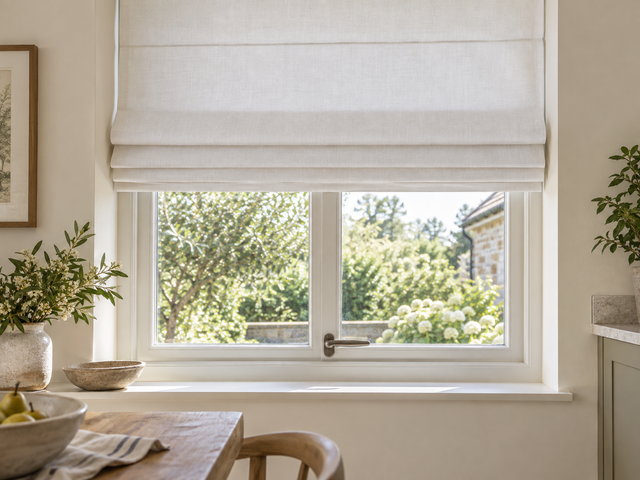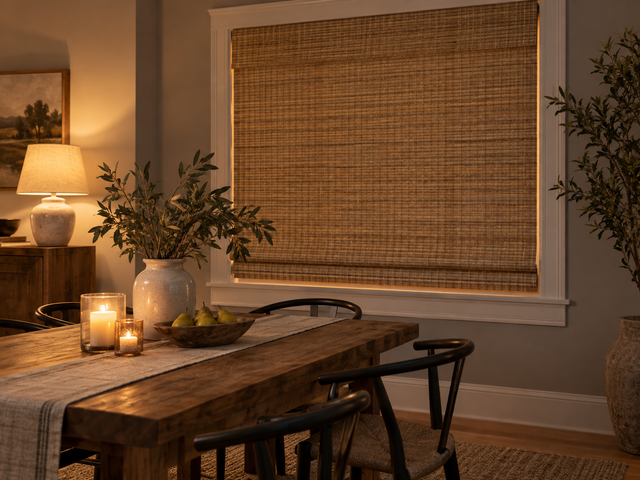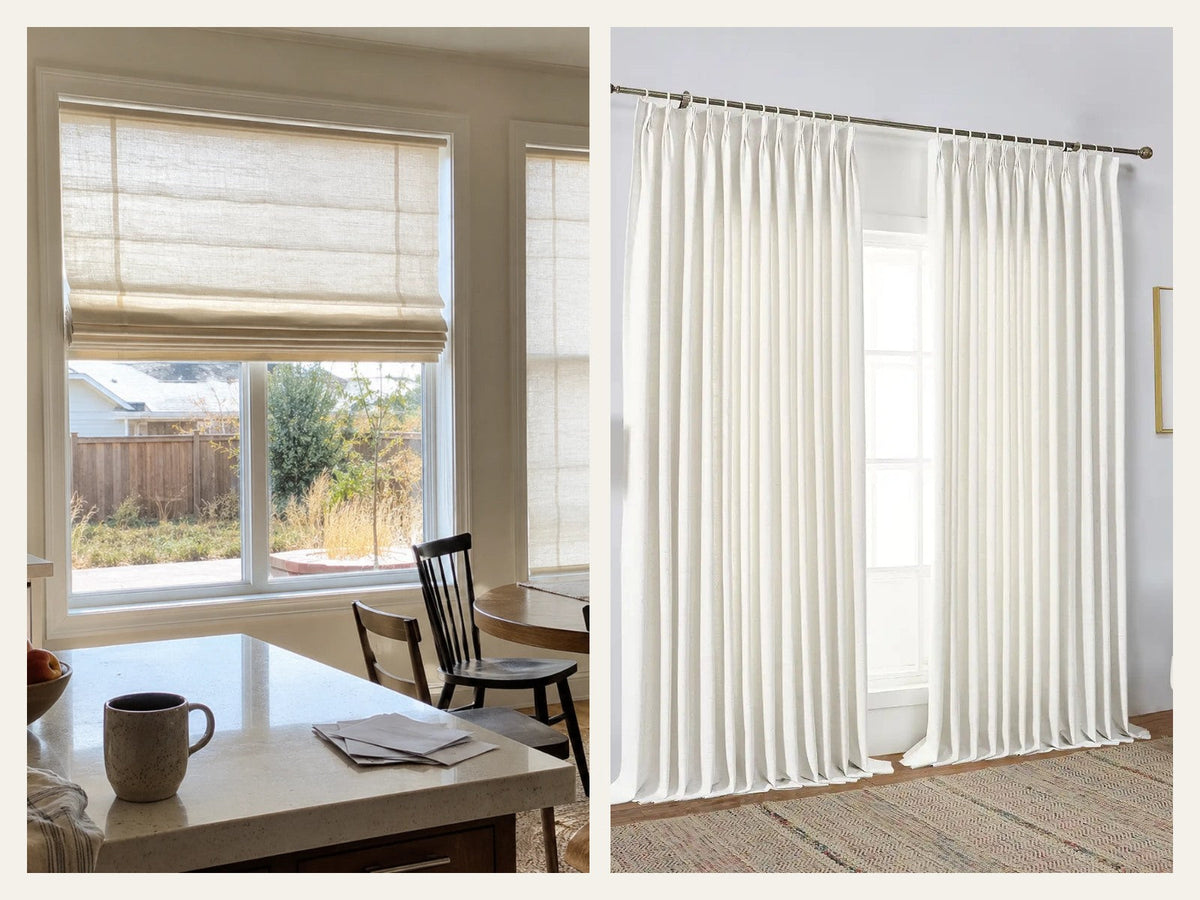

Picture a bedroom window behind a nightstand. Full-length panels may bunch against the furniture, while a Roman shade can stay within the opening. At a wide living room window, the opposite may be true: curtains can frame the view and connect the window to the entire wall. The better choice depends on the layout before it depends on color.
One window, two different layouts
| Decision | Roman shades | Curtains |
|---|---|---|
| Space around the window | Compact; useful above furniture or counters | Need room for panels and hardware at the sides |
| Visual effect | Tailored horizontal folds | Softer vertical lines and fuller wall coverage |
| Daylight | Raised from the bottom; product-specific fabric and liner | Panels can stack to the sides; fabric and lining vary |
| Privacy | Depends on weave, liner, mount, and edge gaps | Depends on fabric, lining, panel overlap, and side coverage |
| Measuring | Choose inside or outside mount, then measure width, height, and depth | Plan hardware position, finished width, length, fullness, and overlap |
| Layering | Can sit beneath curtains when each treatment is measured separately | Can frame a shade or work alone |
Roman shades favor a compact footprint. Curtains use more wall space but create a broader frame. Privacy and light control can be built into either approach through material, lining, coverage, and installation.
Choose Roman shades when floor space is tight
A Roman shade is often the cleaner solution above a desk, kitchen counter, radiator, built-in bench, or bed. Because the fabric raises vertically, it does not need the side space that open curtain panels use.
The tradeoff is that the shade needs a suitable mounting area and a clear path to move. Window handles, cranks, trim, shallow frames, and nearby objects should be checked before ordering.
Browse the Custom Roman Shades collection to compare light-filtering, privacy, textured, plain-fold, and top-down/bottom-up options. The Roman Shades Buying Guide puts fabric, liner, mount, lift, and size decisions in a practical order.
The Custom Light Filtering Roman Shade is one product-specific path to review when softened daylight matters. Other shades may offer different options.
Choose curtains when you want broader softness
Curtains can frame a wide opening, cover more wall area, and create a continuous line from the hardware to the floor. They also make it easier to pull the fabric completely away from the glass when there is enough stacking room at the sides.
Plan where the open panels will sit. A beautiful curtain can still feel inconvenient if it blocks a door, crowds a nightstand, covers a vent, or leaves too little space for the window to open.
The Curtains and Drapes collection is the better starting point when full-length fabric is central to the room.
Compare light control as a system
Roman shades and curtains can both be offered with lighter or stronger light control. The final room result depends on more than the fabric label.
For Roman shades, pay attention to the weave, liner, mount, width, and edge gaps. For curtains, look at fabric, lining, panel width, hardware position, center overlap, side return, and finished length.
If darkness matters for sleep or screen use, plan coverage before choosing a color. Neither treatment should be presented as a guarantee that no light will enter around the edges.
Decide by room
Bedroom
Roman shades work well when the bed or nightstand leaves little room for panels. Curtains work well when you want floor-length softness and room for broad side coverage. Either choice needs a nighttime privacy check and a deliberate light-control plan.
Living room
Choose Roman shades for a more contained window treatment or when furniture sits close to the opening. Choose curtains when you want the window to feel connected to a larger wall composition. Layering can provide both effects when there is enough depth and hardware space.
Kitchen or breakfast area
Roman shades usually keep fabric away from floors and work surfaces, but they still need clearance from handles and nearby fixtures. Curtains can suit a larger dining window, while cafe curtains are a separate option for partial coverage.
Home office or media room
Start with glare direction, screen position, and how often the treatment will move. A compact shade can be convenient near a desk. Wider curtains may cover a broader opening, but the hardware and panel stack must be planned.
Think about daily operation
Ask who will adjust the treatment, how often, and whether the top of the window is easy to reach. Options vary by product, so check the control shown on the selected page instead of assuming every Roman shade or curtain operates the same way.
For a layered window, decide whether the shade, curtains, or both will move each day. Separate controls and well-planned hardware are easier to live with than a combination selected only for the photo.
Measure for the treatment you will order
Roman shades require an inside- or outside-mount decision before the final width and height are entered. Inside Mount vs Outside Mount Roman Shades explains how frame depth, trim, hardware, and desired coverage affect that choice. Follow with the Roman Shade Measuring Guide.
Curtains require a hardware plan, finished width, finished length, fullness, and overlap. Use the Drapery Measuring Guide instead of measuring only the glass.
Custom prices vary with product, size, material, lining, and selected options. Compare the final configured price in the cart instead of treating one starting price as a complete room budget.
When layering both makes sense
Layering can pair the compact control of a shade with the softness of curtain panels. It is useful when the shade handles everyday coverage and the curtains frame the opening or add another fabric layer.
Before choosing both, make sure the window has enough depth and wall space for separate hardware. Measure the shade and curtains independently, and decide how each will operate without rubbing or blocking the other.
If the choice is still close
Sketch both options over a photo of the wall. Mark the curtain stack beside the glass, then mark the raised depth and finished edges of a Roman shade. The drawing usually reveals whether furniture, trim, a vent, or the view makes one option easier to live with.
For a layered treatment, give each part a clear job: the shade might manage everyday coverage while stationary curtains soften the wall. If neither layout is obvious, send the photo and measurements to Fredesigner support before ordering.