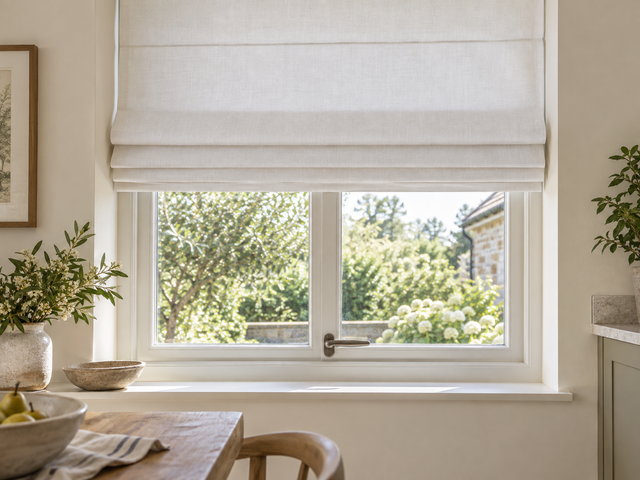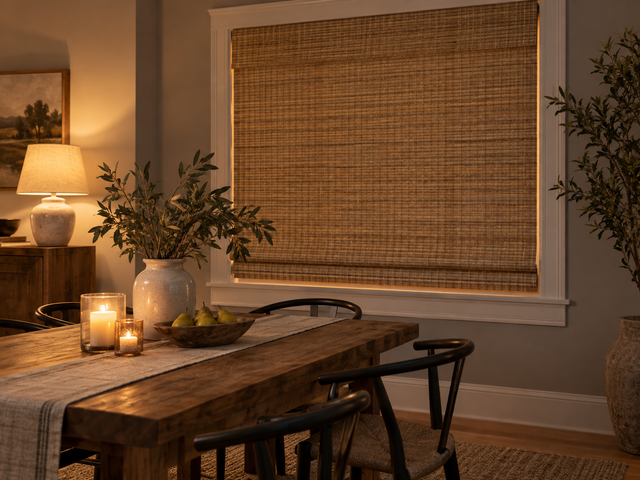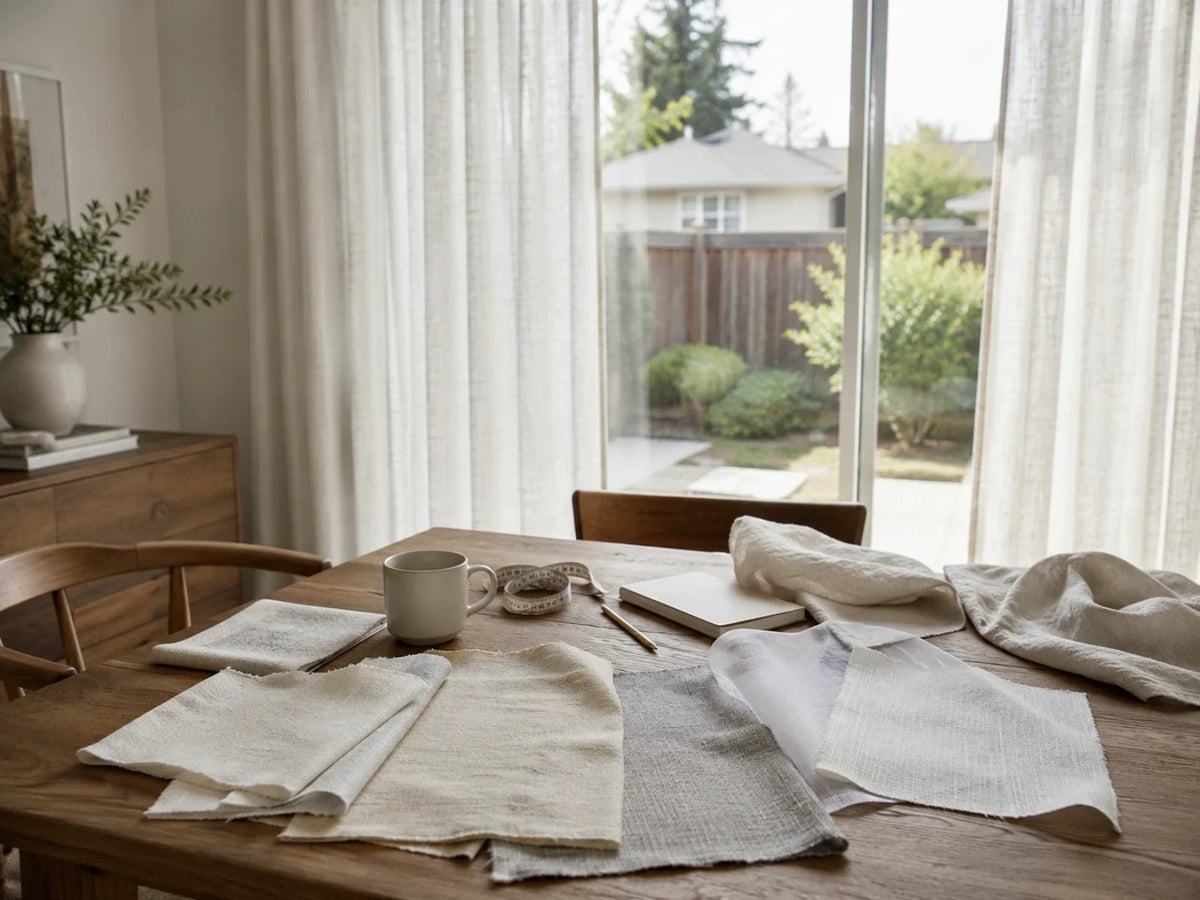

Order fabric samples before a custom curtain or Roman shade purchase when color, texture, weave, opacity, or lining will affect the decision. Test each sample at the actual window in morning, afternoon, and evening light, and view it from inside and outside. Check the listed sample price and eligibility conditions before placing the order.
What a sample can answer
Online images are useful for narrowing a palette, but they cannot reproduce every screen setting, wall color, lamp, or window direction. A physical sample shows how the material responds to the room. It also lets you compare neighboring finishes that will remain after the treatment is installed.
A sample can help answer:
- Does the color lean warm, cool, gray, or green beside the wall?
- Is the weave quiet from across the room or visibly textured?
- How much light passes through the material in this room?
- Does the reverse side look appropriate from outside?
- How does an available liner change color, body, and opacity?
- Does the surface work beside flooring, furniture, and bedding?
It cannot prove every finished-treatment result. Panel fullness, lining, mount, hardware, finished size, overlap, and edge gaps still matter.
Order the right sample path
Use the curtain sample-book collection for curtain fabrics and the Roman shade sample-book collection for shade materials. Review the listed price, included materials, and eligibility before checkout.
A sample collection may not represent every product or option. Match the sample name or code to the curtain or Roman shade you plan to order, and ask Fredesigner support when the relationship is unclear.
Test samples in a repeatable way
1. Label every sample
Keep the product name, color, and code attached. Photograph the label with the fabric so the preferred option can be identified later.
2. Place it at the window
Tape or clip the sample where the treatment will hang without damaging the fabric or wall. View it with the window uncovered, then place it over a white and darker background to understand how surrounding color affects it.
3. Check three lighting periods
Review the sample in daylight, late-day light, and with the room's normal lamps. Take photographs from the same position, but use the physical comparison as the deciding evidence because phone cameras also shift color.
4. Check privacy from both sides
Stand outside after dark when interior lights are on, where safe and practical. Open-weave materials can behave differently at night than during the day. A sheer or light-filtering sample should not be treated as a universal privacy guarantee.
5. Compare the intended lining
If the product offers a liner, place the materials together and repeat the light and color test. The liner and interlining guide can help organize the choice, while the product page determines availability.
Keep one note for each finalist
Create one set of notes for each serious candidate—Sample A, Sample B, and Sample C—then compare them side by side. Record daylight undertone, evening color under the room's lamps, texture, the view from both sides, and any change created by an offered liner. End each note with a simple keep-or-remove decision.
Limit the final round to a few serious candidates. Too many near-identical choices make the decision harder without adding useful evidence.
Test for the intended product
Curtains and Roman shades use fabric differently. Curtains hang in folds and may overlap, while a Roman shade raises into horizontal folds and sits within or over a defined opening. A sample should therefore be evaluated with the finished product in mind.
Browse curtains and drapery or custom Roman shades, then review the material, lining, header or mount, controls, and custom fields. Fredesigner's fabric selection guide can support the qualitative comparison.
Measure after the material choice is clear
Fabric choice and measuring are separate decisions. Once the material and lining choices are settled, use the applicable guide for the finished treatment. Curtain allowances and shade deductions are not interchangeable.
Use the drapery measuring guide for curtains and the Roman shade measuring guide for shades. Record final dimensions in inches and recheck every custom field.
Final sample check
- Match each sample to the product you plan to order.
- Check sample price, contents, and eligibility.
- Compare color at three times of day.
- Review texture from close up and across the room.
- Check view-through from inside and outside.
- Repeat the test with the intended lining when available.
- Keep the selected sample until the finished treatment arrives.
The sample does not make the decision by itself; it removes guesswork from the parts a screen cannot show. Use it alongside the product details, the correct measuring guide, and the actual room.