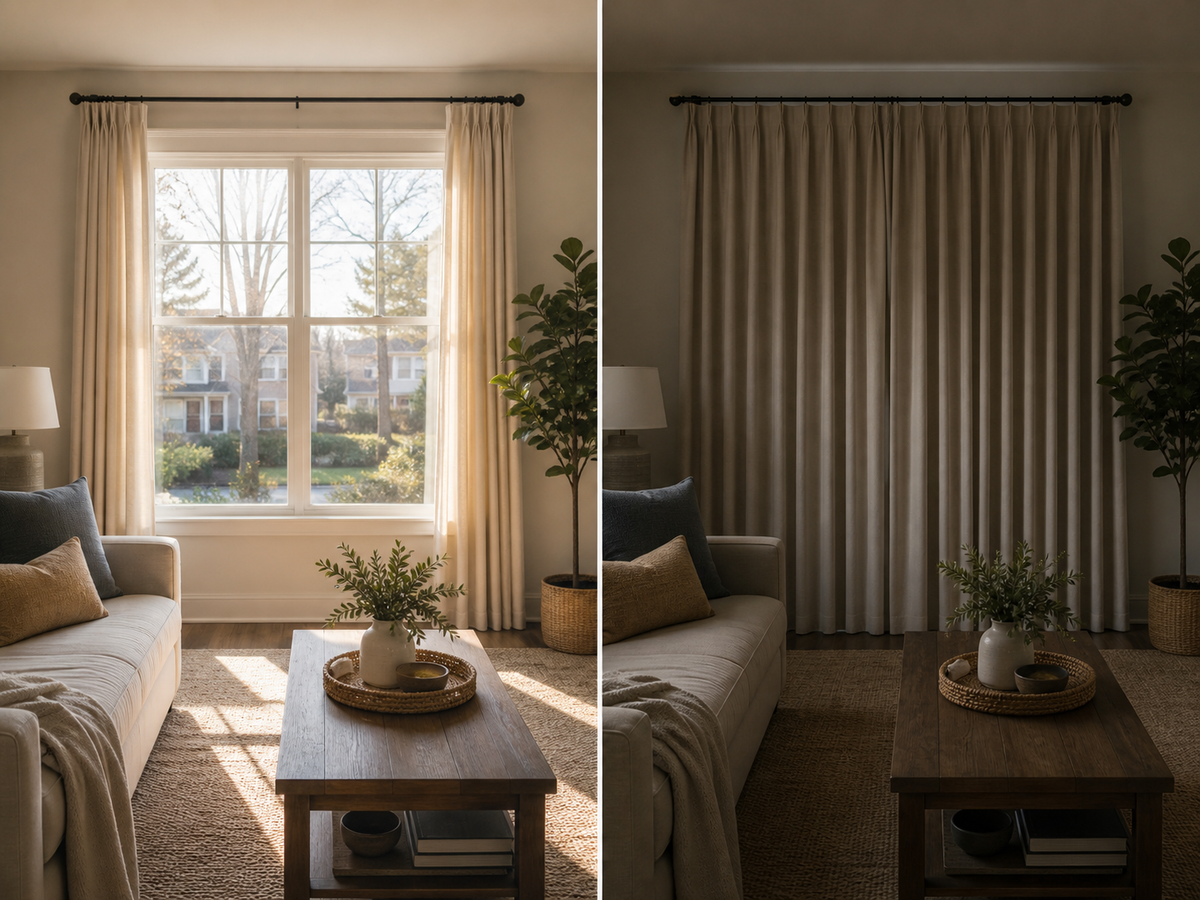

The most useful curtain routine changes with the season and the window's direction. Open panels when daylight or winter sun helps the room, and close them before harsh afternoon sun or a cold evening makes the window area uncomfortable. This is a comfort strategy, not a promise about energy use or utility bills.
Notice when the window changes the room
Spend one ordinary day noting what happens beside the window. A west-facing living room may be comfortable in the morning and glaring at 4 p.m. A bedroom may feel fine at sunset but noticeably cooler beside the glass before dawn. Those time-specific observations are more useful than a general wish for an "insulating curtain."
Moving air suggests a draft or gap that curtains cannot repair. Cold glass, direct sun, and glare are different conditions and may call for different responses. For help telling them apart, read what curtains can and cannot fix about drafty windows.
A cold-weather routine
On a bright winter morning, opening the curtains may bring useful daylight or sun into the room. As the sun moves away and the glass becomes colder, closing the panels can create a visual and physical layer between the occupied room and the window.
Close the panels early enough that the routine is easy to remember. In a bedroom, that may be part of the evening privacy routine. In a living room, it may happen when lamps come on. Keep fabric clear of heaters, radiators, fireplaces, vents, and other heat sources, and follow the equipment manufacturer's clearance instructions.
A warm-weather routine
For a window that receives strong afternoon sun, close the treatment before the brightest period and reopen it after the direct sun has passed if daylight is still useful.
A home office may need only the panel nearest a screen to move. A living room with two exposures may use one set of curtains in the morning and another later in the day. Seasonal use does not have to mean closing every curtain for the same number of hours.
Match coverage to the routine
Panels that are difficult to reach or too cramped to stack are unlikely to be used consistently. Mark where they will rest when open, how they will meet at the center, and what they will cover at the sides. Check handles, doors, furniture, baseboards, floor conditions, and walking paths.
Coverage also affects light. A narrow panel can leave a bright side gap even when the fabric itself is opaque. A layered arrangement may provide more adjustment than one fixed level of coverage, but it should remain simple enough to operate every day.
Choose fabric and lining for the room
Use Fredesigner's fabric selection guide to compare texture, opacity, privacy, and room use. The liner and interlining guide explains the qualitative differences among available layers. Then check the material, color, care, lining, and header offered on the curtain you are considering.
A heavier appearance does not guarantee a thermal result, and a blackout category does not guarantee a room without edge light. Choose these features for the documented privacy, light-control, body, and design effect.
Test the routine before ordering
For several days, use temporary markers or existing shades to note when you would want the planned curtains open and closed. Watch a west-facing room in late afternoon and a bedroom near dawn. This reveals whether the main issue is direct sun, privacy, cold glass, moving air, or inconvenient operation.
Once the hardware position is clear, use Fredesigner's drapery measuring guide to record finished width and length in inches. The finished treatment should support the routine without blocking vents, heat sources, doors, or normal movement.
The goal is not to keep curtains permanently open or closed. It is to give each room a small, repeatable response to the light and window conditions that actually occur there.