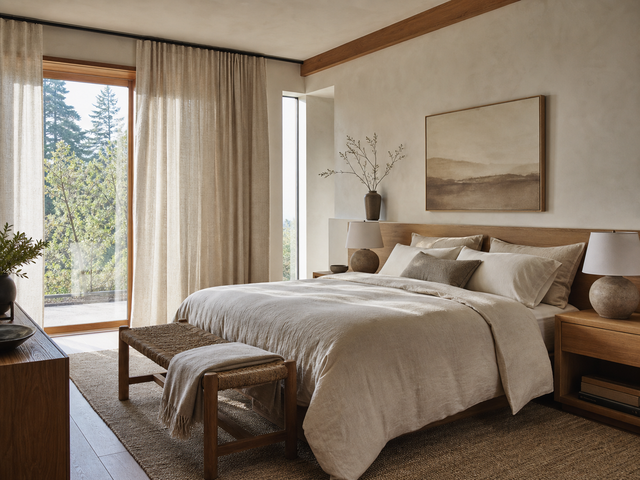

Imagine a duvet cover described as “natural linen-look bedding.” That short phrase combines a broad claim with a style description, but it still does not tell you the fiber content. Read a listing like this in four passes: fiber, construction, care, and evidence for any added environmental or health claim.
First, separate fiber from appearance
“Linen-look” describes an appearance; it does not mean the fabric contains linen. “Natural” may suggest a source or aesthetic, but it does not explain the percentages, processing, finish, dye, components, or supply chain.
Look for a clear statement such as “55% linen, 45% cotton.” That identifies a blend. A phrase such as “linen texture” or “natural weave” does not.
The Federal Trade Commission's Green Guides summary cautions marketers about broad, unqualified environmental-benefit claims. For a shopper, the practical response is to look for a specific claim and evidence that matches it.
Then read the construction
| Listing language | What it tells you | What is still missing |
|---|---|---|
| Linen-look duvet cover | The surface is intended to resemble linen | Fiber percentages, weave, finish, and included pieces |
| Double-layer gauze | A layered construction is being described | Fiber content, layer attachment, weight, and care |
| Washed finish | A finish or appearance is being described | The process, expected variation, and care directions |
| Natural color | A color description | Fiber source, dye information, and environmental evidence |
| Certified material | A certification is being referenced | Standard, number, scope, product match, and validity |
Construction affects the visible surface and how the item is assembled. It does not establish cooling, allergy relief, durability, organic content, or environmental performance.
Check fit and care in your own routine
A product can use an accurately labeled fiber and still be the wrong choice for your bed. Confirm the listed dimensions, included pieces, closure, insert attachments, and care directions. A bulky cover may be inconvenient in a compact washer even when its dimensions suit the insert.
The Linen Bedding collection, Bedding collection, and Duvet Covers collection are useful places to find a product type. After that, the product page should provide the details used for the decision.
Treat bamboo wording as a fiber-label question
The FTC's bamboo textiles guidance explains that textiles made from rayon or viscose produced from bamboo should be labeled with the manufactured-fiber name rather than simply called bamboo.
For example, “viscose made from bamboo” identifies a manufactured fiber and its source. It does not, by itself, mean organic content, reduced environmental impact, or a health benefit.
Ask what a certification actually covers
A certification can support only the question and scope it actually covers. Record the standard name, issuer, certificate or label number, exact product or component, scope, and current validity.
A supplier certificate may cover fabric rather than the finished bedding item. A facility certificate may address a different scope altogether. If the product match is unclear, compare the disclosed material, construction, fit, and care without assuming the broader claim.
Return to the imaginary “natural linen-look duvet cover.” A useful listing would add the exact fiber percentages, weave or layer construction, set contents, dimensions, closure, attachments, and care. Any organic, certified, lower-emitting, healthier, or environmentally preferable claim would need its own evidence. That is enough information to make a real comparison without asking one vague word to do all the work.