
A fiber name alone does not establish allergy performance. NIEHS notes that dust mites can live in bedding and other soft furnishings. A more useful shopping approach is to identify the trigger, choose bedding the household can clean as directed, and follow qualified health guidance.
Begin with the trigger, not the textile
Allergy management starts with identifying the actual trigger. Dust mites, pet dander, mold, pollen, fragrances, and detergent residue are different problems, so one material cannot be presented as a universal answer.
The National Institute of Environmental Health Sciences lists several household steps for reducing dust-mite exposure rather than presenting one textile as a complete solution. Its dust-mite guidance provides the full context.
That general guidance does not prove that a particular Fredesigner sheet, duvet cover, or curtain prevents symptoms. A medical concern should be discussed with a qualified healthcare professional.
What a product page can tell you
| Detail | Why it matters | What it does not prove |
|---|---|---|
| Complete fiber statement | Identifies the material sold | That the item will prevent an allergic reaction |
| Construction and layers | Shows how the item is assembled | That dust or allergens cannot collect on it |
| Care instructions | Tells you whether routine cleaning is practical | That every household should use the same wash method |
| Closure and removable parts | Helps plan regular maintenance | That the product is medically protective |
| Current certification record | Defines a tested article and scope | That unrelated products have the same status |
The Bedding collection can help narrow the product type. The useful details are the fiber statement, construction, removable parts, and care instructions for the item under consideration.
Washability is a practical buying question
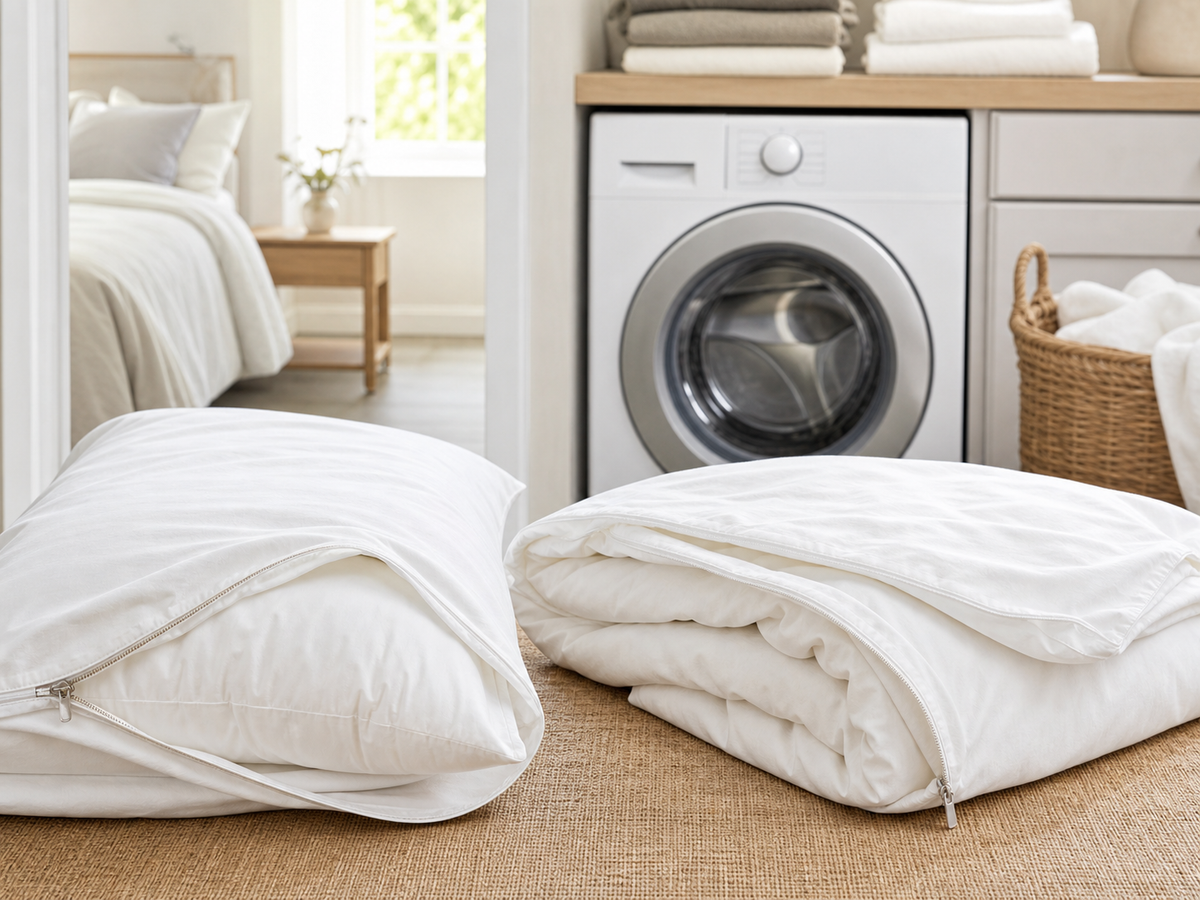
Consider whether the cover can be removed, which wash and dry methods the manufacturer permits, and whether the household can keep up with that routine. A product that requires care you cannot maintain may be a poor fit even when its texture feels comfortable.
For duvet covers, review the closure, internal ties, seam construction, and care label. The current Duvet Covers collection is a browsing path, not proof of allergy performance.
If you are comparing linen-labeled items, use the Linen Bedding collection to locate products, then read the fiber disclosure and care instructions for each item.
Claims that require stronger evidence
Words such as hypoallergenic, antibacterial, anti-mite, asthma-safe, non-toxic, and chemical-free are not interchangeable. Each claim needs a defined test, an exact product or component, a current result, and a clear explanation of what the result covers.
Natural appearance is not a test result. A linen texture does not establish medical suitability, and a cotton label does not tell you which dyes, finishes, fillings, threads, or closures are present.
No Fredesigner bedding item is identified here as hypoallergenic or suitable for a medical condition. If a listing uses a health-related term, ask what was tested, which item or component the result covers, and whether the document is current.
Build a routine the household can keep
Start with professional or public-health guidance for the known trigger. Then choose the bedding type, fiber disclosure, removable parts, and care method that fit that plan. A washable cover is only practical when the washer, dryer, drying space, and cleaning schedule can support it.
The most useful purchase is not the one with the strongest wellness language. It is the one whose materials and care are clear enough for the household and its healthcare adviser to evaluate.