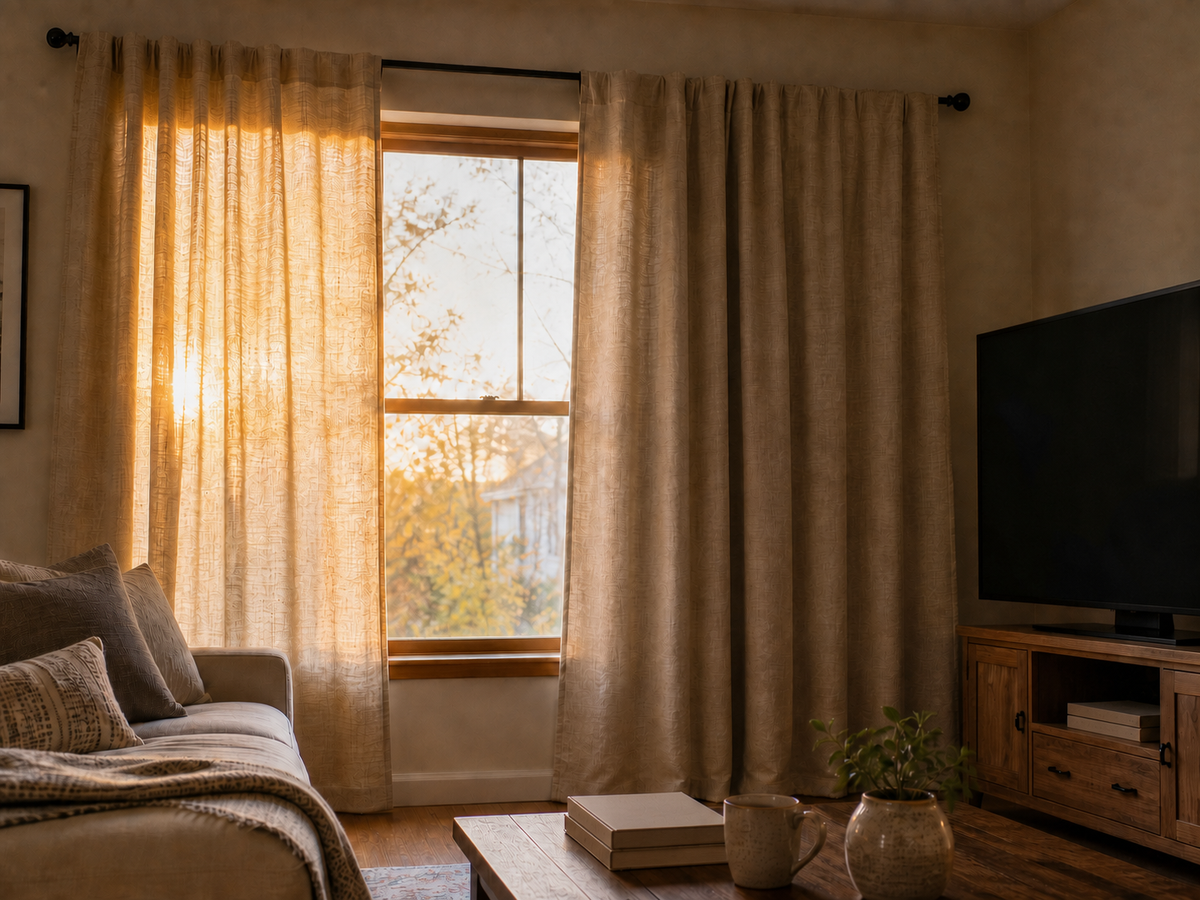

West-facing rooms usually receive their strongest direct light later in the day, so choose curtains for the hours when glare, heat near the window, privacy, or sleep are most difficult. Start with the room's activity, then coordinate fabric, lining, panel coverage, hardware position, and finished measurements. A darker room is not automatically the right answer.
Identify the late-day problem
Watch the room from midafternoon through sunset on a clear day. Note when light reaches a television, monitor, sofa, dining table, artwork, or bed. The problem may last only an hour, or it may shift across the room for much of the evening.
Separate glare from brightness. A room can feel pleasantly bright while a small area of direct light makes a screen difficult to use. That situation may need flexible coverage rather than the darkest available fabric.
| Room use | Main late-day issue | Direction to compare |
|---|---|---|
| Living room with a television | Moving screen glare | Panels that close quickly, with enough side and center coverage |
| Home office | Direct light on monitor or face | Adjustable layering and controlled gaps |
| Bedroom | Evening privacy or early bedtime | Stronger light-control fabric or lining with planned coverage |
| Dining area | Harsh light at the table | Light-filtering fabric that softens the view |
| Multiuse room | Different needs across the evening | Separate sheer and main-curtain layers |
Choose light control by activity
Use a lighter curtain when the goal is to soften direct light without making the room feel closed. Consider stronger light control when sleep, a media setup, or a bright exterior source makes reduced brightness more important. Fredesigner's fabric selection guide can help organize those qualitative choices.
For product ideas, compare blackout curtains with the broader curtains and drapery collection. Review the material, lining, header, color, and size on each product page because room results vary within a category.
Treat lining and coverage as one decision
Fabric and lining influence the light passing through the panel, while hardware position and finished size influence the light traveling around it. Side gaps, center gaps, top placement, floor clearance, and the space needed when panels are open all affect the experience.
The liner and interlining guide describes privacy, light control, and body in qualitative terms. Check whether the selected product offers the option you want before ordering. Product-specific evidence is needed for any percentage or complete-darkness claim.
Layer when the room needs two different settings
Layering can preserve daytime softness and provide a more private or darker evening setting. A sheer inner layer handles the bright view, while the main curtain closes when direct light reaches the activity area. Both layers need sufficient hardware clearance and stacking space.
Layering is most useful when the room changes function. A living room may need daylight for most of the day and screen control near sunset; a bedroom may need a lighter daytime view and more coverage at night. Plan how each layer moves and where it rests when open.
Test fabric at the west-facing window
Order fabric samples when available and check the listed price and eligibility conditions. Place each sample at the actual window during the late-afternoon period, then view it from the room and from outside after dark. A fabric that looks neutral in morning light may shift warmer under evening sun.
Fold the sample over itself or place it beside the intended lining to compare density and color interaction. Test it near the television, wall paint, flooring, and lamps. The goal is to understand the room, not to judge the fabric on a phone screen.
Measure the complete coverage area
Plan the rod or track before entering a custom size. Record the finished width and finished length in inches, along with side extension, center meeting point, floor endpoint, trim, furniture, vents, and stacking space. Follow Fredesigner's drapery measuring guide for the applicable method.
Use only allowances that apply to the selected header and treatment. If the window is unusual or the hardware plan is unclear, send photos and measurements to Fredesigner support before checkout.
Make the final choice
- Observe the room during the strongest west light.
- Identify the activity affected by glare or brightness.
- Choose lighter, stronger, or layered light control.
- Compare fabric and lining at the actual window.
- Plan side, center, top, and floor coverage.
- Measure from the intended hardware in inches.
- Review the product options and custom fields.
The best curtain for a west-facing room is the one that solves the difficult hour without compromising the rest of the day. Let the room schedule lead, then use fabric, lining, and finished coverage to support it.