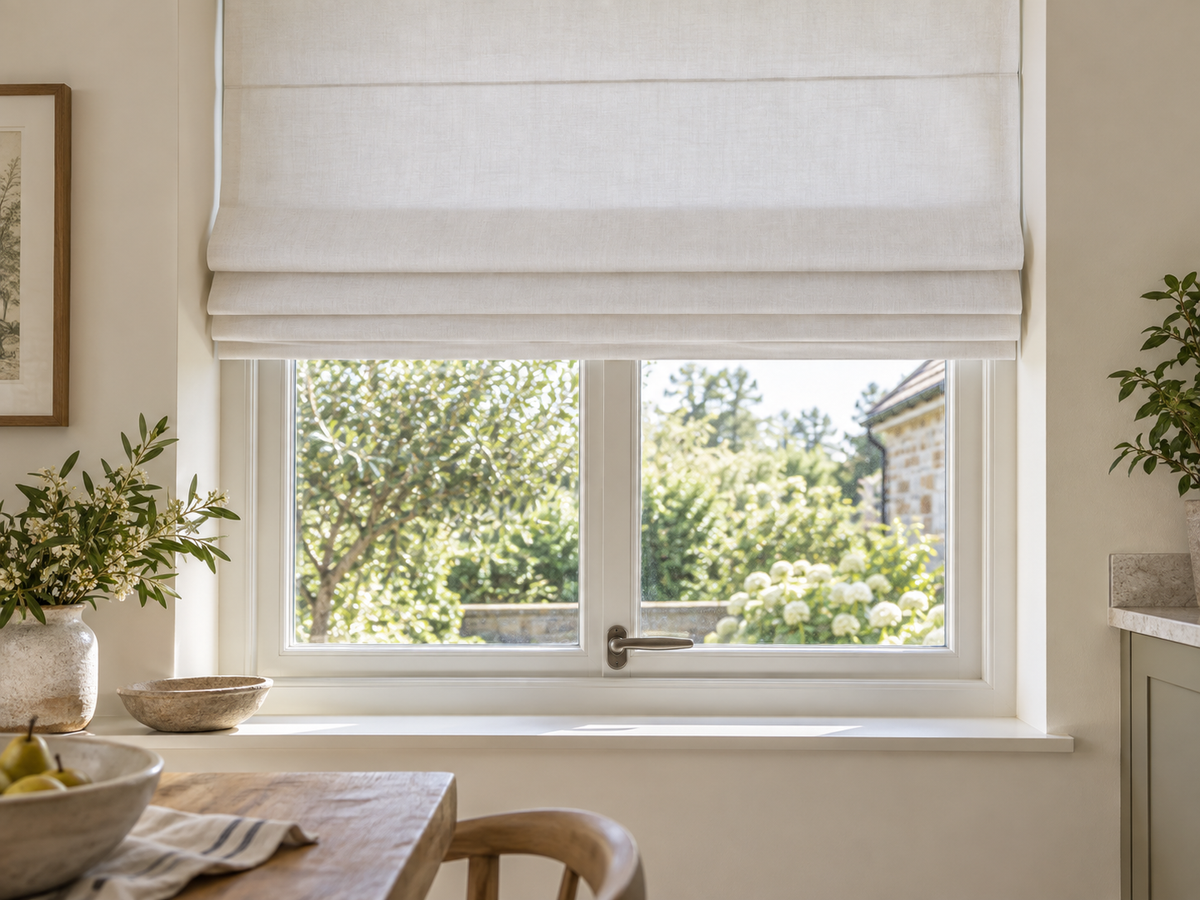
A Roman shade is a workable fit when its brackets can be mounted as specified, the fabric does not catch the window hardware during the intended operation, and the raised folds leave the required window-opening path clear. Check both the treatment and window through their normal movements. As a starting point, a standard Roman shade headrail needs at least 2 inches of flat depth to sit inside the frame (motorized shades need 2 1/2 inches). Then compare that with how far the handle projects into the room.
Which three clearances should you check?
The mounting surface, the path of the hanging shade, and the space occupied by raised folds are not interchangeable. A bracket may fit at the top of the frame while the fabric below it rubs against a projecting crank. A raised shade may also sit where an inward-opening sash needs to move.
Two measurements usually settle the first question: the clear depth of the frame and how far the handle projects from the glass. With an inside mount, the fabric hangs roughly in line with the front of the headrail; if the handle reaches past that line, the lowered shade will rest against it. An outside mount on the wall or trim above the frame moves the fabric forward and often clears the handle—compare the handle's projection with the trim depth before you order.
Use the Roman shade measuring guide for the actual order dimensions. Alongside those measurements, make a separate obstacle sketch. It should show what projects into the opening and what moves when you operate the window.
Run through the window's normal movements
- Open and close the window without a treatment in the way. Note the full path of the handle and sash.
- Identify where a lowered shade would hang relative to the handle. Look from the side, not only from the front.
- Mark the proposed top position on a photograph and ask where the raised folds would sit for your selected size.
- Check whether you could still reach the lock and remove or operate the screen as intended.
Do not attach improvised hardware or force a sash against fabric to test a fit. Photos and product-specific dimensions are the safer starting point for resolving an uncertain installation.
A shallow frame does not answer the whole question
Moving the shade outside the opening may provide another mounting location, but it does not automatically clear a projecting handle. The shade still hangs in a particular plane. Decorative trim, an adjacent cabinet, or a wall return can limit that placement.
Likewise, moving a shade higher may change where its raised folds sit, but it also changes the area the ordered shade must cover. Confirm the complete arrangement before measuring the final height.
What should you send for a fit review?
- A straight-on photo showing the whole opening and surrounding trim.
- A side view showing the handle's projection.
- A photo with the sash open in its usual position.
- The selected product, intended mount, frame measurements, and any nearby obstruction.
For example, the Custom White Linen Plain Fold Roman Shade can be ordered as an inside or outside mount. Send Fredesigner support the side-view photo of the handle with your frame measurements and ask which mount clears it.
Order after the operating path is clear
Browse custom Roman shades once you know the window's constraints. The useful finish line is simple: the chosen treatment can move as intended, the window remains usable, and the submitted dimensions match the confirmed mounting plan.