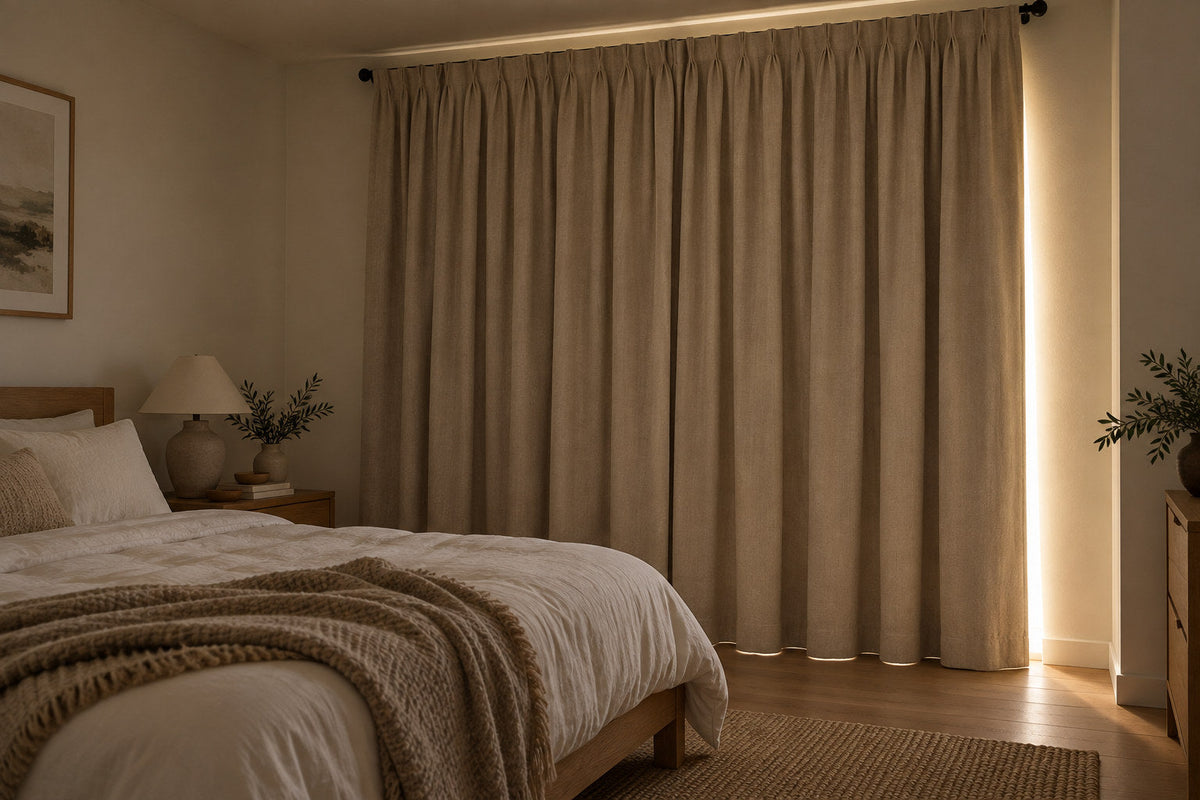

If blackout curtains still let light in, first check where the light appears. A broad glow across the fabric points you toward the ordered fabric and lining; a bright line at the top, side or center points you toward coverage and closure. Photograph the window at the time the light bothers you. Replacing the face fabric alone will not necessarily close those gaps.
Start at the time the light bothers you: early morning, an afternoon nap or after the streetlights turn on. A quick check at another time can miss the problem entirely.
Make a simple light map
Close the curtains as you normally do and turn off the room lights. Look from the bed or other place where you notice the brightness. Then stand closer to the window and identify the brightest areas: across the fabric, above the header, at the outer edges, between the panels or below the hem.
Take one photograph of the whole window and a closer photograph of each troublesome area. Note the time, the sun or streetlight direction and whether both panels are fully closed. Phone cameras can exaggerate brightness, so include a short description of what you see with your eyes.
If you are browsing the blackout curtain collection, keep that map nearby. It is more useful than a general request to make the room darker.
If the fabric itself appears to glow
A broad glow across the curtain surface suggests that light transmission through the selected configuration deserves a closer look. Confirm the actual order: face fabric, lining and any specified light-control option. The word “blackout” in a general description does not answer what was selected for your individual panels.
Check whether the lining is present and whether it covers the intended area. Fredesigner’s lining guide can help you identify the options, but the order record and product configuration are the starting point. If only a small spot is unexpectedly bright, photograph that spot rather than treating it as a room-wide fabric problem.
A textured fabric such as Bolonia curtains is a style choice; the finished panel’s lining and construction must also be considered for light control. A room photograph cannot establish the darkness your selected configuration will provide.
If the brightness follows an edge
Look at where the curtain ends relative to the window. At the sides, fabric may cover the glass from a straight-on viewpoint while leaving a clear route for light behind it. At the top, a space between the hanging header and the wall can admit daylight. A curtain that sits well forward of the window can make that route more apparent.

Use this comparison to organize your next step. It is a starting point for inspection, not a diagnosis from a photograph alone.
| Where the light appears | What to check | Useful next step |
|---|---|---|
| Across much of the fabric | The ordered face fabric and lining | Compare the order record with the finished panels. |
| Above the curtain | Header position and the route behind the hardware | Ask the installer whether the existing layout can reduce that route. |
| Along an outer side | Window coverage and distance from the wall | Record the gap from the room and from the side. |
| Between two panels | Closure, attachment position and panel coverage | Check whether the panels meet as intended without forcing them. |
Check the closure before changing the hardware
At the center, first confirm that nothing is stopping the panels from reaching their intended positions. A caught fold or an attachment at the wrong position can leave a gap. Do not pull harder against resistance; inspect the header and hardware arrangement instead. The header-style guide helps identify the attachment type you are looking at.
If the curtain simply does not cover the intended area, compare the installed dimensions with the original measurements. Use the drapery measuring guide and keep its measuring basis separate from an improvised adjustment.
Send the order details, light map and photographs through Fredesigner’s contact page if the configuration is unclear. Before making any change, write down what you expect that change to address. Then repeat the check at the same troublesome time. The useful result is a smaller unwanted light path where you actually notice it.