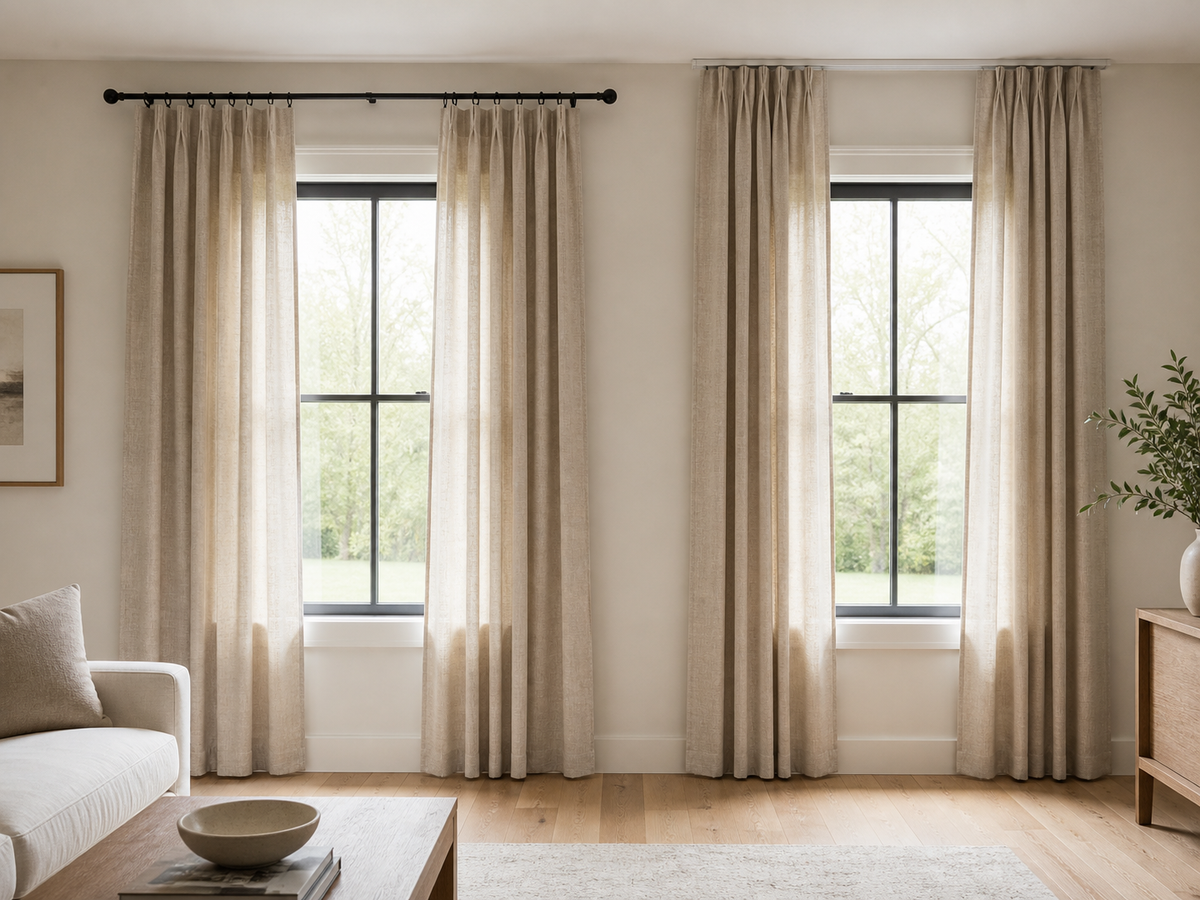
Choose a curtain rod when your selected header is built to slide over or hang from a visible pole. Choose a track when the selected header is designed for compatible hooks or carriers and your layout calls for a guided path. Decide the hardware first, then measure the finished span and length; a beautiful fabric cannot correct a header that does not fit the support system.
The useful question is not whether tracks or rods are universally better. It is whether the hardware, header, mounting surface, movement path, and measurements form one workable plan for your room.
Begin with the hardware you already have
If a rod is already installed, record its usable span, pole diameter, bracket positions, and the way the panels must pass along it. If a track is installed, identify its carriers, hooks, tape, channels, and any joints or corners. Those details matter before you select a header.
If no hardware is installed, choose the hardware and header together. Check the mounting surface, the direction the curtains will open, and where the panels can rest when open. For an unusual opening, confirm the plan with the hardware supplier or installer before ordering custom dimensions.
| Starting point | Verify before ordering | Next action |
|---|---|---|
| Existing rod | Usable span, pole diameter, brackets, and movement path | Select a compatible header, then measure the usable rod span and finished length |
| Existing track | Carrier, hook, tape, channel, joint, and corner details | Match the header to that system, then measure the usable track span and finished length |
| No hardware | Mounting surface, opening direction, and space for the panels to stack when open | Choose hardware and header together before entering dimensions |
| Unusual opening | Shape, corners, trim, furniture, and obstructions | Share the room plan with a qualified installer or support team |
Treat the header and hardware as one choice
A header is the top construction that connects the curtain to its support. Some headers are designed around a pole, while others depend on compatible rings, hooks, or carriers. For example, a rod-pocket header is made for a rod to slide through its pocket. Other headers have different attachment requirements.
Review Fredesigner's Header Styles Guide, then confirm the selected header on the product page. Do not assume that every header works with both systems or that one set of accessories fits every product.
Check how the curtains will move
Picture the curtains closed, partly open, and fully open. Decide whether the panels meet in the center or move toward one side. Check whether brackets, track joints, corners, handles, furniture, or nearby doors interrupt the path. Also reserve enough clear space for the open panels so they do not cover the part of the window or doorway you need to use.
If you expect to open and close the curtains often, test the planned movement with the hardware supplier or installer. A layout that looks balanced when closed can still be inconvenient if the panels cannot move or stack where intended.
Confirm support before choosing the final fabric plan
Fabric, finished dimensions, header construction, and any selected lining all contribute to the final panel configuration and weight. Hardware limits vary by product and installation. Ask the hardware manufacturer or installer to confirm that the chosen rod, track, brackets, fasteners, and mounting surface suit the completed curtain plan.
This is especially important when the span is long, the panels are large, or the mounting surface is uncertain. Fredesigner can help with curtain options, but the hardware and installation still need to be verified for the room.
Measure the system, not only the glass
Custom curtain measurements should describe the finished coverage and the planned hardware span, not just the visible glass. Decide where the rod or track will sit, where the curtains should begin and end, and how the panels should clear the floor or sill.
Use the Drapery Measuring Guide after the hardware and header are selected. If the installation plan changes, measure again before checkout rather than reusing dimensions from an earlier layout.
Use Fredesigner pages in this order
- Compare top constructions in the Header Styles Guide.
- Browse the current Linen Curtains collection to compare fabric and ordering options.
- Open a current product, such as Linen Blend Drapery Soft Top Sedona, and confirm the header choices available on that product.
- Follow the Drapery Measuring Guide for the finished plan.
Final pre-order check
- The header is compatible with the exact rod, rings, hooks, carriers, or track being used.
- The mounting surface and hardware have been reviewed for the completed curtain plan.
- The panels can open, close, and rest without conflicting with brackets, handles, furniture, or doors.
- The submitted width and length match the planned hardware position and finished coverage.
- The product page, header guide, and measuring guide have been checked together before checkout.
Once those five details align, you can move on to fabric and style. If any one detail is uncertain, pause before entering custom measurements and confirm it with Fredesigner support or the installer responsible for the hardware.