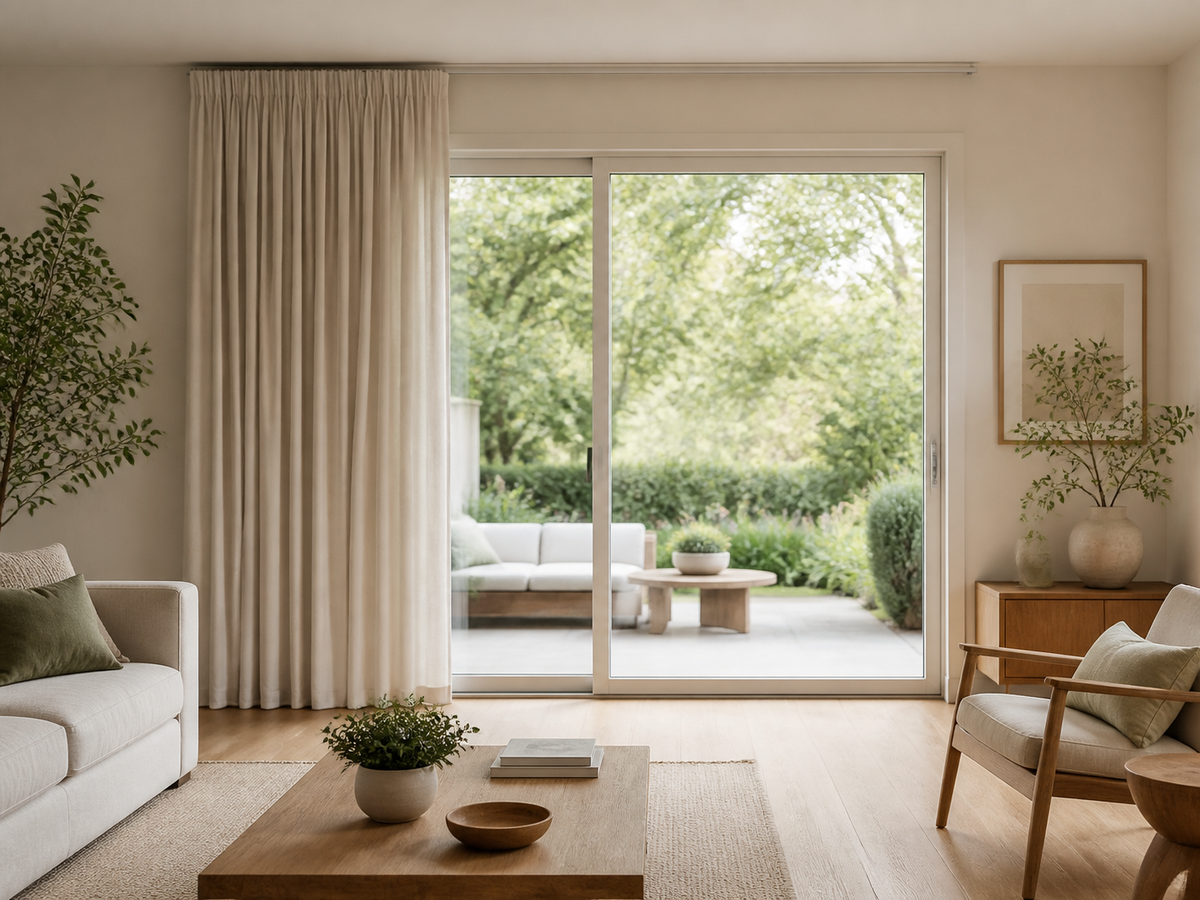
For sliding glass door curtains, choose a one-way opening when daily traffic and the active door favor one clear parking side. Choose a center opening when the doorway is balanced and both sides have room for the fabric stacks. Mark the active panel, walking path, handles, furniture, hardware, and desired finished coverage before ordering; the layout decision should come before fabric and lining.
Start with the door you actually use
Stand inside the room and identify which glass panel moves, which edge you reach for, and where you normally walk through. Then mark anything that limits the curtain path: a door handle, wall return, cabinet, sofa, floor vent, or narrow corner. This simple map shows where the fabric can park when the door is open.
Do not assume that a symmetrical door needs a symmetrical curtain. The best layout follows the way the room works. If people regularly enter through one end, the curtain should not have to cross that route every time the door opens.
Choose a one-way opening for a clear parking side
A one-way opening pulls the curtain toward one side. It is a practical option when the active door and walking path favor the same direction, and the opposite side has enough uninterrupted space for the fabric. The goal is to place the open curtain away from the area you reach through most often.
Before choosing this layout, check the full wall beside the glass rather than only the door frame. A nearby chair, shelf, switch, or corner can reduce usable stack space. For a broad opening, compare the available configurations in the Extra Wide Curtains collection. One current product example is the Sedge extra-wide pleated curtain; review its selectable options before ordering.
Choose a center opening when both sides can hold fabric
A center-opening layout uses curtain sections that separate in the middle and park on opposite sides. It can suit a balanced wall when both ends of the opening have usable space and the center is the natural point of access or view. It also lets you move one side without moving the other.
Check each side independently. One side may look open in a photo but still contain the active door handle, a tight return, or furniture that prevents a clean stack. If one parking zone is clearly better than the other, a one-way plan may fit the room more naturally.
Plan the stack before selecting fabric
Open curtains still occupy space. Use removable tape to outline the intended hardware span and the two possible parking zones. Walk through the door, operate the handle, and look at the glass from the main seating area. This dry run will reveal whether a one-way stack blocks the wrong edge or whether two stacks make the room feel crowded.
Only after the opening direction is settled should you compare fabric and lining options. Those choices belong to the final configuration, not the first layout decision.
Match the header and hardware to the movement
The header, rod or track, and panel layout need to work as one system. A curtain used several times a day has a different operating role from a decorative panel that usually stays in place. Review the available header styles, then confirm that the selected product options fit the hardware and opening direction you intend to use.
If the hardware is not installed yet, decide its span only after checking trim, handles, ceiling conditions, and the intended fabric parking area. If hardware already exists, measure the actual setup and plan around it instead of relying on the glass dimensions alone.
Measure the finished coverage, not just the glass
Your order should follow the finished area the curtain needs to cover. That may differ from the visible glass or door-frame width. Record the planned hardware span, finished drop, opening direction, number of sections, and the side or sides where the fabric will park.
Use the Fredesigner drapery measuring guide for the ordering measurements. Keep a simple sketch with the active door, hardware endpoints, obstructions, and finished coverage labeled so the numbers remain tied to the layout.
Final layout check
- Which glass panel is active?
- Where is the everyday walking path?
- Which side can hold the open fabric without conflict?
- Would two smaller parking zones work better than one larger zone?
- Do the handle, trim, furniture, and hardware stay clear?
- Are your measurements based on the intended finished coverage?
When those answers are clear, the choice becomes straightforward: use one-way opening for the stronger parking side, or center opening when the room supports two balanced stacks. Then select the curtain configuration that matches the plan.