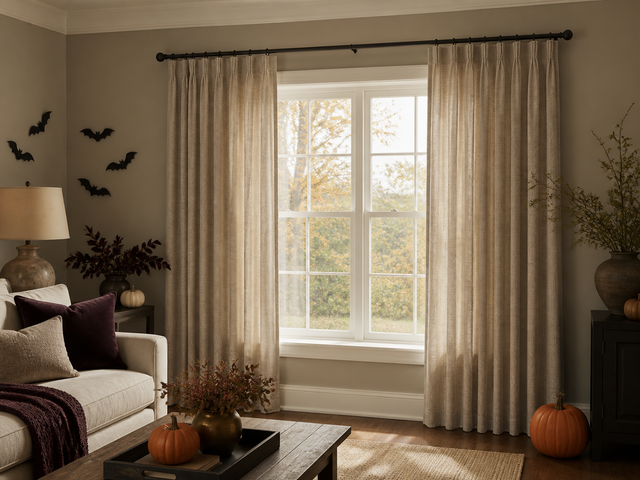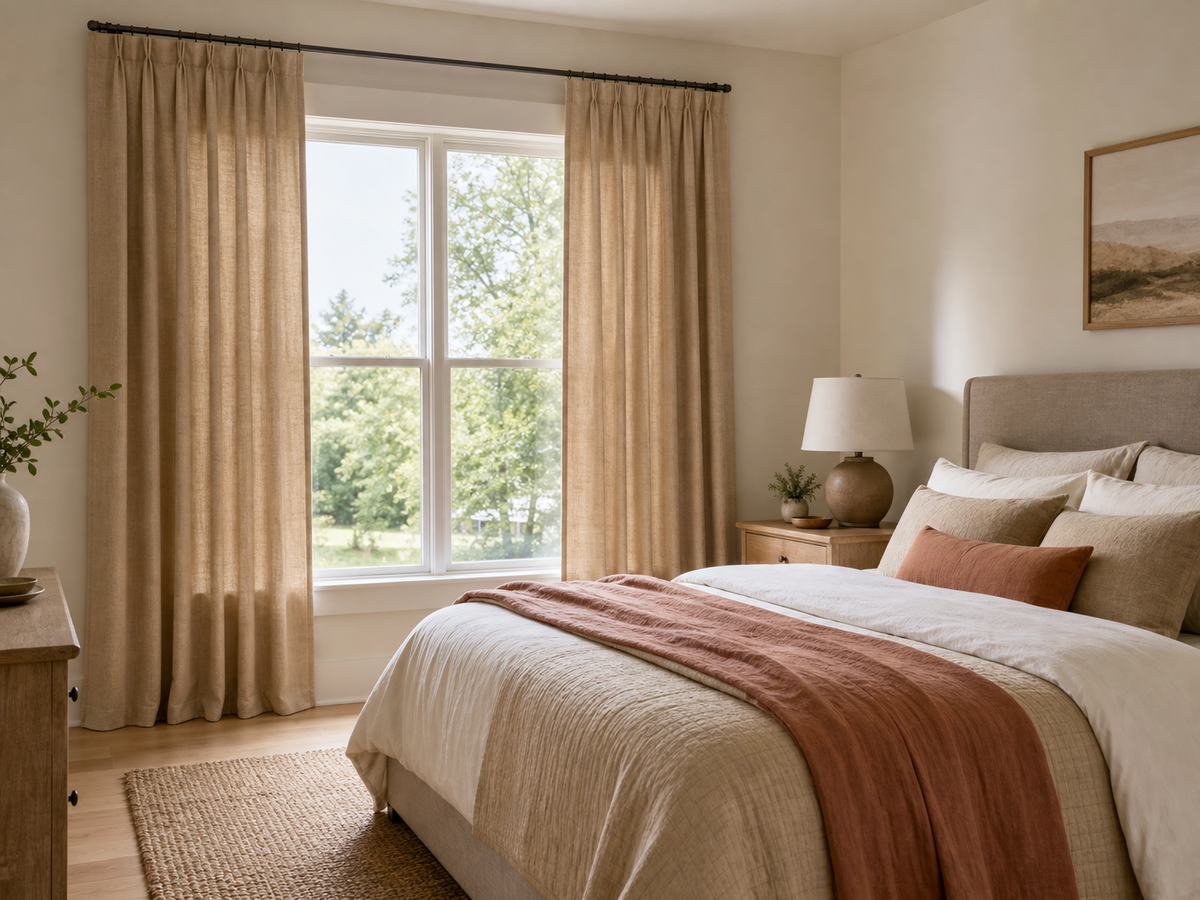

Choose bedroom curtain color by matching undertones, not by chasing one universal best shade. Start with the room's fixed surfaces—walls, flooring, headboard, and large bedding pieces—then view the fabric in morning, afternoon, and lamplight. Decide privacy and light control before color, because lining and fabric construction can change the final appearance.
Start with the room's undertone
White, beige, gray, green, blue, and brown all have warmer or cooler versions. A curtain can look neutral on screen and still turn pink, yellow, green, or blue beside the wall.
Look at the largest fixed surfaces first:
- Warm wood, cream paint, brass, and rust-colored accents often pair easily with warm ivory, oatmeal, camel, clay, or muted olive.
- Cool gray flooring, blue-white paint, nickel, and slate accents often work with soft white, mushroom, blue-gray, charcoal, or restrained green.
- Mixed rooms need a bridge color that appears in more than one place, such as a warm gray that connects cool walls with natural wood.
These are starting points, not rules. The real fabric in the real room is the better test.
Use this decision table
| Room condition | Colors to test | What to watch |
|---|---|---|
| Warm white or cream walls | Oatmeal, warm ivory, sand, muted olive | Avoid a blue-white curtain that makes the wall look yellow |
| Cool white or pale gray walls | Soft white, mushroom, blue-gray, charcoal | Avoid a strong yellow beige unless another warm element connects it |
| Dark wall color | Related mid-tone or intentional light contrast | Make sure the curtain does not disappear at night |
| Patterned bedding | Pull one quieter background color | Avoid matching every accent color |
| Natural wood headboard or floor | Warm neutral, mineral green, or soft contrast | Compare the wood's red, yellow, or gray undertone |
| Small bedroom | Low-contrast color can feel calmer | Privacy and darkness still matter more than visual lightness |
Decide whether the curtains should blend or frame
Choose a low-contrast color when you want the window to sit quietly within the wall. A curtain close to the paint color can create a continuous backdrop, especially when the room already has patterned bedding or artwork.
Choose more contrast when the window needs a defined frame. A deeper neutral, blue, green, or earthy tone can anchor a pale room, but repeat that color elsewhere in a smaller detail so it feels connected.
Avoid choosing contrast only from a small online swatch. Large panels cover much more visual area and may read darker or more saturated than expected.
Let bedding guide the balance
The curtain does not need to be a perfect match for the duvet. A perfect match can make a room feel overly coordinated and becomes difficult when bedding changes.
Instead, identify the bedding's dominant background color and one secondary tone. Use the curtain to repeat the background, echo the secondary tone, or add a quiet neutral that connects both.
If the bedding has a strong print, a solid or lightly textured curtain often provides visual rest. If the bedding is plain, the curtain can carry more texture without adding another pattern.
Check daylight and evening light
North-facing rooms can make colors feel cooler and flatter. South- or west-facing light can bring out yellow, red, or orange undertones. Trees, neighboring buildings, and painted exterior surfaces can also cast color into the room.
Evening lamps change the comparison again. A beige that looks balanced in daylight may look much warmer under a lamp, while a cool gray may lose its softness.
View the relevant sample near the window, beside the bedding, and against the wall at several times of day. Check the listed sample price and make sure it belongs to the curtain product you plan to order.
Choose light control before the final color
A bedroom curtain must meet privacy and darkness needs before it completes the palette. The selected fabric, lining, finished width, hardware position, overlap, and edge coverage all affect the result.
Browse Bedroom Curtains for a broad room-based path or Blackout Curtains when stronger light control is the priority. Blackout vs Room Darkening Curtains can help define that requirement before color takes over the decision. A dark face fabric is not automatically stronger at light control than a lighter fabric with an appropriate lining.
Lining can change how the face fabric hangs and appears. Review the selected product and configuration before choosing the final shade.
A practical color test
- Photograph the room in daylight and with evening lamps on.
- Identify the walls' warm or cool undertone.
- Note the flooring, headboard, and largest bedding colors.
- Choose one blending option and one contrasting option to compare.
- Place relevant samples vertically beside the window.
- View them from the doorway and from the bed.
- Choose light control, lining, and finished coverage before ordering.
Common mistakes
- Calling every beige warm or every gray cool.
- Matching only a throw pillow instead of the room's larger surfaces.
- Choosing color before privacy and light-control requirements.
- Judging a fabric from a phone screen.
- Comparing a small flat sample only under ceiling light.
- Forgetting that large finished panels make color more prominent.
If the room has mixed undertones or the choice remains uncertain, contact Fredesigner support with daylight photos and the product you are considering.