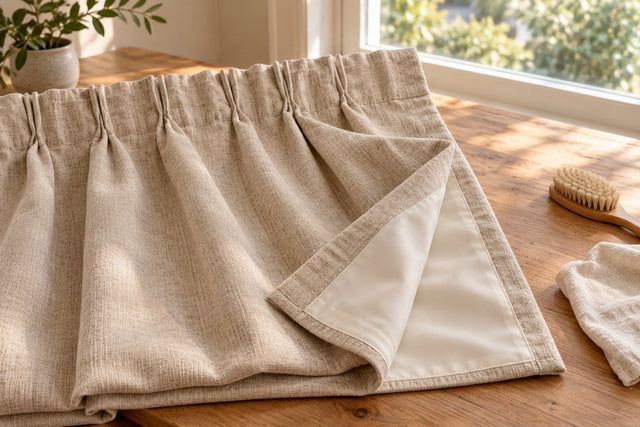
Start with where the curtain catches, then choose the next check. If a loose object is holding the hem, clear the object and try one short, gentle movement. If it catches at a rod joint, bracket or track carrier, stop and check the hardware instructions or supplier guidance before changing anything.
Find the repeatable point of resistance
From a comfortable standing position, observe the curtain moving gently in its usual direction. Does it catch at one spot every time, resist along most of the opening, or become difficult only as the panels gather? Stop if a fixing looks loose, a component moves unexpectedly or the fabric starts to pull out of shape.
Write down which panel is affected and whether it happens when opening, closing or both. A short video can be useful if the problem is visible from the floor. There is no need to climb up or dismantle the hardware simply to document the movement.
Look below the header as well. A lower edge held behind the sofa, caught on a sill or dragging across a rug can feel like a fault at the top. Note whether the cloth has a clear route before assessing the moving components.
If the hem drags because the curtain hangs slightly low, the header may give you some adjustment. Fredesigner's pinch pleat, pinch pleat with back tab, triple pinch pleat, tailor pleat, triple tailor pleat and flat-hook headers come with adjustable pin hooks, which let you raise or lower the panel a little without altering the fabric. Check the hem against the floor across the whole width first; floors are not always level.
Also record when the problem began. Did the curtain move normally before a furniture change, a recent rehang or a hardware adjustment? That detail can help the supplier distinguish an ongoing configuration question from something that changed recently.
Identify the header and attachment system
Find the header listed on the curtain order and compare it with the header style guide. Then identify the hardware carrying it: rings on a rod, carriers in a track or another specified system. Include the exact hardware model if you know it.
A product's face fabric does not settle this question. If you ordered Sedona linen-blend drapery, the selected header and the hardware used with it still need to be considered together. Before ordering a replacement from the curtain collection, find out whether the difficulty comes from the fabric's configuration, the hardware or the installation.
The guide to curtain tracks and rods explains the broader hardware choices. For an installed system, however, the hardware manufacturer's instructions and the actual configuration are the useful reference.

Describe the symptom without guessing at a repair
| What you notice | What to document | Who can assess it |
|---|---|---|
| Resistance at one point | The location and any nearby joint, bracket or carrier | Hardware supplier or installer |
| Difficulty along most of the opening | Header, attachments and hardware model | Hardware supplier, with curtain configuration details |
| Fabric catches below the header | The sill, furniture, rug or hem contact | Installer or curtain supplier if the fit is unclear |
| Panels crowd when fully open | Available parking space and gathered panels | Curtain supplier and installer |
Use the result to choose your next step. If clearing a loose obstruction restores the movement, check the normal route slowly. If resistance returns at the same upper point, stop there and show that location to the hardware supplier. Resistance along most of the run needs the header and attachments checked against the actual hardware instructions, rather than another attempt to pull harder.
Do not add oil, wax or another lubricant unless the hardware instructions specifically allow it. Do not change hooks, carriers or brackets based only on a photograph of a different system. The correct next step depends on what is installed.
If the curtain travels normally until it reaches the open position, the panels may simply need more room to park. Fredesigner's curtain pages estimate that open panels take up about one-fifth of the width they cover when closed—roughly 20 inches on a 100-inch rod. Compare that with the space beside the window using the stackback planning guide. Crowded fabric and a faulty moving component are different questions, even when both make opening difficult.
Send a useful support record
Include the curtain order, selected header, hardware brand or model, and the direction and location of the problem. Add one whole-window photo and a close view taken safely from an accessible position. If an installer supplied the hardware, include their details so the configuration can be checked.
Check the setup against Fredesigner's installation guides for your product, then send the record through Fredesigner support, together with the header name from your order confirmation. That gives the supplier something concrete to review and helps you decide what needs attention before buying new parts.
AI-generated styling illustrations; see the product page for exact fabric and configuration.