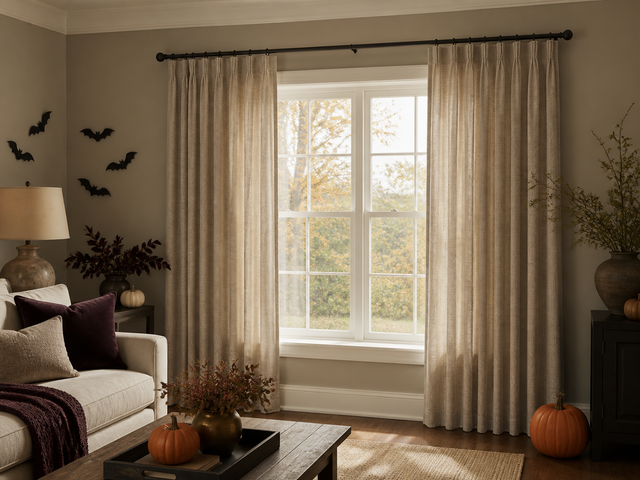

An online curtain shop earns trust when you can tell what will be made before you pay. The fabric, lining, header, finished size, care, measuring method, and policy should be easy to find and easy to connect to the order form. A low price or a polished room image cannot replace that information.
Look for product-level information
A useful product page should make it possible to identify what you are buying. Check for:
- Fiber or material statement.
- Available color and fabric choices.
- Available lining and header options.
- Finished-size fields and any stated limits.
- Hardware or installation context where relevant.
- Care instructions.
- Price, lead-time language, and stock or availability.
An option shown in a general guide may not appear on every curtain. The product page and its order form should agree.
Measure the retailer's guidance, not just your window
Custom curtains depend on the planned rod or track, header, finished width, finished length, floor relationship, and panel layout. A retailer should distinguish finished curtain dimensions from the glass opening.
Review Fredesigner's drapery measuring guide as an example of the decisions involved. Keep any numeric allowance tied to the header and installation scenario described by the guide.
If the window is unusual, the shop should provide a way to clarify the configuration before ordering. Photos, wall measurements, trim details, and hardware plans can be more useful than one unexplained number.
Look for clear fabric and sample information
Room photography, close fabric views, and sample-book options can help you compare color, weave, and opacity. Screen color alone is not reliable because displays and room lighting vary.
Check the actual price and conditions attached to any sample offer. Do not rely on a page label if the product page or checkout shows a charge.
If a shop uses a percentage or makes broad claims about blackout, energy savings, health, environmental performance, or certification, look for the product and setup the claim covers.
Read policies before entering a custom size
Custom and made-to-order products may have conditions that differ from standard merchandise. Find the live return, cancellation, change, shipping, damage, and order-review information before checkout.
Look for the deadline and method for correcting an order, which products or configurations can be returned, and what evidence is required for damage or defects. Shipping destinations, timing, tracking, and the buyer's measurement responsibility should also be stated clearly.
Policies can change, so read the retailer's live pages instead of relying on a blog summary.
Evaluate support with a real question
Send one question that includes your product, header, window type, and specific uncertainty. A useful response should address that configuration, not repeat generic marketing copy.
For Fredesigner, the custom curtains and drapes guide and how-to-order page provide starting points. Read the selected product page and applicable policy before purchase.
Compare total decision quality
Price matters, but compare what the price includes: fabric, lining, header, finished dimensions, panel count, and any optional construction. Two listings with similar room photos may describe different products.
Use the same written specification when comparing shops. This keeps a basic unlined panel from being compared with a lined custom configuration as if they were equivalent.
Try to describe the order in one sentence
Before paying, you should be able to state the product, fabric, color, lining, header, panel count, finished size, and hardware plan without guessing. Compare that sentence with the cart and save the measuring method and policy you used.
If an important detail is still unclear, send the shop one specific question and keep the answer with the order. Browse Fredesigner's curtain collection when you are ready to compare products. A trustworthy buying path leaves little room for surprise when the custom panels arrive.