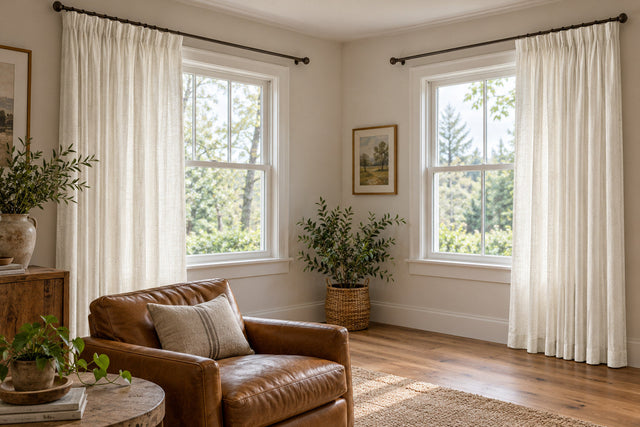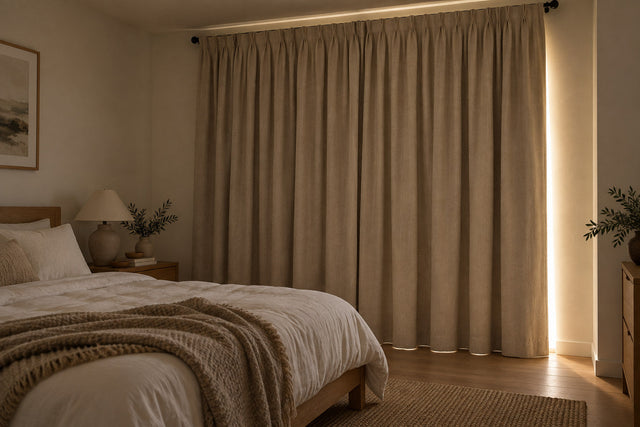

You can often add curtains without taking down the blinds you already have. The deciding question is whether the new curtain can pass in front of the blind, its brackets and its controls without rubbing or getting caught. Check that space before choosing a fabric or ordering a finished length.
It helps to think of the window as two separate systems. The blind stays where it is and does its usual job. The curtain needs its own support, a clear route across the opening and somewhere to sit when open.
Start with the blind you actually use
Look at the whole installation, not just the slats or shade fabric. A headrail, bracket cover or valance may project farther into the room than the blind itself. A tilt wand can move outward as you turn it. A shade may take up more space when raised than it does when lowered.
Open and close the window treatment through its full range, then operate the window too. Write down the parts that come closest to the proposed curtain position. If a handle swings outward, that movement belongs on the list. A straight-on photo and a side photo make these details easier to discuss with an installer.
Decide what you want to keep about the existing blind. Perhaps it handles midday glare well, but the room feels unfinished around the edges. In that case, curtains may provide the softer outline you want. If you also need more darkness at bedtime, choose the curtain configuration for that purpose rather than assuming any second layer will do it.
Check the clearance from the side
A curtain rod above the window is not automatically far enough forward. The curtain hangs below its rings, hooks or other attachments, and the folds take up depth. The relevant space is the distance between the frontmost moving part of the blind and the back of the hanging curtain.
Ask the hardware supplier or installer to check that space for the intended header and fabric. There is no single bracket projection that works with every blind. Longer brackets also change the demands on the fixing points, so avoid solving a collision by adding an improvised extender.

For an outer fabric layer, Fredesigner’s Sedona linen-blend drapery is one option to consider. Its face fabric is listed as 20% linen and 80% polyester. Check the selected header and lining as part of the order; fabric alone does not establish how the curtain will sit in front of your existing hardware. You can compare other fabrics in the curtain collection after the layout is settled.
Give both layers an opening routine
Try the sequence you will use on an ordinary morning. Can you move the curtain aside, reach the blind control and raise the blind without leaning over furniture? When everything is closed, can you adjust the blind without trapping a wand or cord in a curtain fold?
A deep curtain stack beside the window can hide a control that was easy to reach before. Check both sides, especially if one is next to a sofa arm or cabinet. Our guide to where open curtains go explains why that side space matters as much as the glass width.
- Blind lowered, curtains open: the blind should move and tilt without dragging the curtain.
- Blind raised, curtains closing: the curtain should pass the raised stack, headrail and controls.
- Both layers closed: attachments and controls should stay accessible without being tangled together.
Measure the new curtain from its own hardware
The blind's measurements are not the measurements for your curtain. Once the mounting position and hardware are confirmed, use the applicable instructions for the outer layer. Fredesigner’s header-style guide helps identify the attachment you are ordering; the drapery measuring guide provides the corresponding measuring steps.
Check the floor route too. A radiator, deep sill or piece of furniture may sit directly below the curtain even when the top clears the blind. Choose the finished drop for that actual route, not for an unobstructed window in a product photograph.
Before placing the order, you should be able to describe three things clearly: where the curtain is supported, what it must clear and where it rests when open. If any of those is still uncertain, send photos and measurements through Fredesigner’s contact page. Resolving a clearance question now is easier than trying to make two installed systems share the same space.