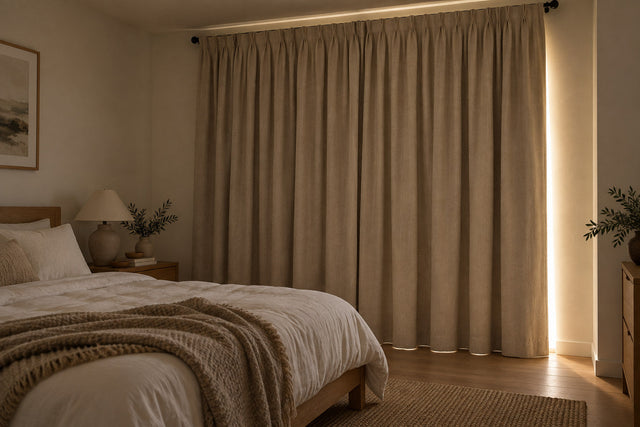
Buy custom curtains in stages by planning the whole home first, then ordering the rooms with the clearest privacy or daily-use needs. Keep windows that must coordinate closely in the same planning group. Record the exact fabric and configuration for later phases, but do not assume future stock, dye lots, prices, or options will remain unchanged.
Make a window list before a shopping list
Give every opening a room name and a simple label. Note when the room is used, whether evening privacy is needed, what treatment already exists, and whether its window is visible from another room. This turns an open-ended decorating project into specific decisions.
Do not copy dimensions between similar-looking windows. Measure each one for its own hardware and installation plan when that phase is ready to order.
Choose the first phase by need
- Privacy first: prioritize occupied rooms where the existing treatment does not meet your evening needs.
- Daily function next: consider workspaces, frequently used living areas, and windows that are difficult to operate with the current arrangement.
- Decorative completion later: a room that already functions comfortably may wait while you resolve more important openings.
These are planning priorities, not reasons to rush a custom measurement. Finish the mounting, fabric, lining, and quantity decisions for each order before purchasing.
Group windows that need to relate
A living and dining area seen together may deserve a shared fabric review even if you furnish the rooms separately. Adjacent panels or matching pairs are especially important to discuss as a group because later material variation may be more noticeable when pieces hang side by side.
If exact matching matters, ask Fredesigner support what can be coordinated in one order and what cannot be promised for a later purchase. Keeping a sample is useful for comparison; it is not a reservation of future material.
Compare complete configurations
Build each phase around the selected fabric, lining, header, finished size, and panel quantity. Add the hardware and installation arrangements you actually need to the planning total. A starting product price is not necessarily the price of your finished room.
Browse the Curtains collection for candidates, then inspect a specific product such as Sedona Linen Blend Drapery Soft Top. Compare the current selected configuration at checkout. Do not project an old quote or promotion onto a later phase.
Keep a record that the next order can use
Save the product link, color name or code, sample information, header, lining, window label, measurements, quantity, and order confirmation. Photograph the installed room in daylight and evening lighting, noting any practical changes you would make for the next space.
Before the next purchase, recheck the current product options and follow the drapery measuring guide again. A phased plan works best when it preserves clear decisions while leaving room to respond to what the first finished room teaches you.