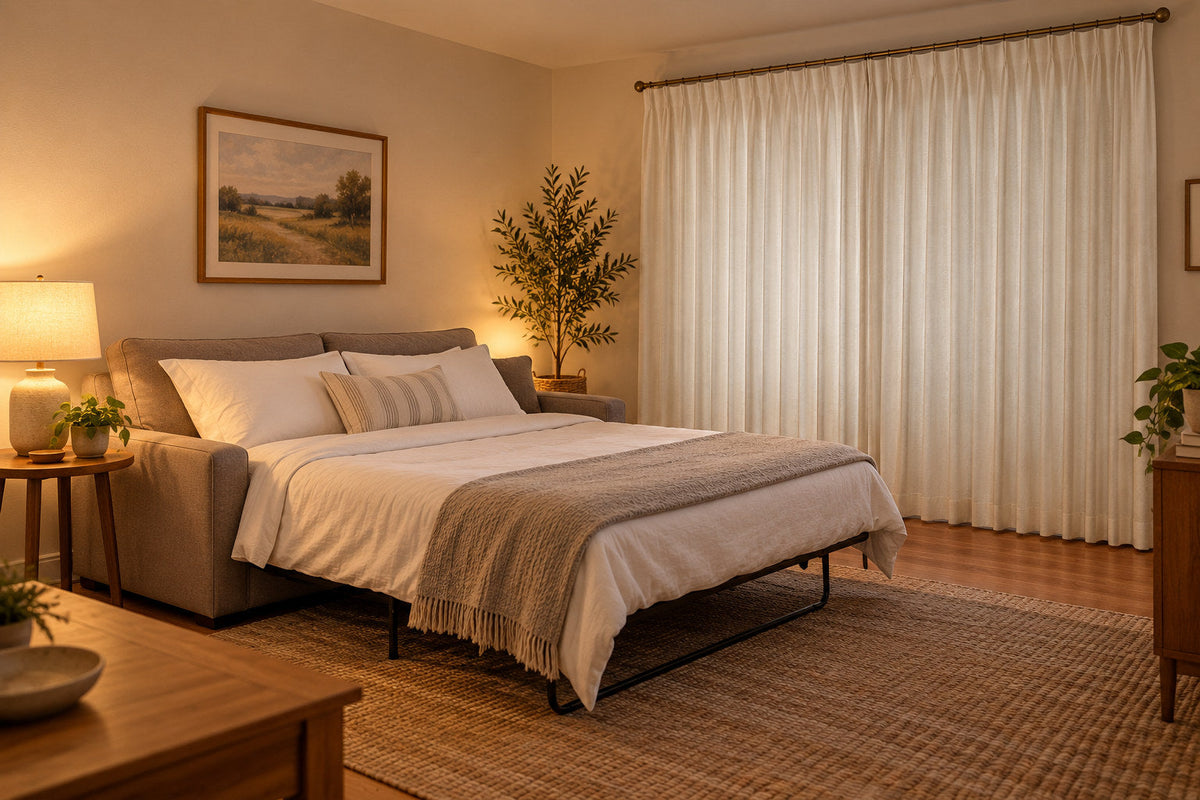
A living room that doubles as a guest room needs daytime light control, nighttime privacy and curtains a guest can reach with the sofa bed open. If an existing blind already provides nighttime coverage, the outer curtains can frame the window. Otherwise, choose the curtain’s lining and coverage for sleep first, then test the opening routine with the bed fully unfolded.
Look at the window from the pillow
The window may feel pleasantly bright when you sit on the sofa and surprisingly exposed when you lie down. Before choosing a new curtain, unfold the bed in its usual position. Check the view from each pillow, including the streetlight that sits just above the sofa back and the neighboring window you rarely notice during the day.
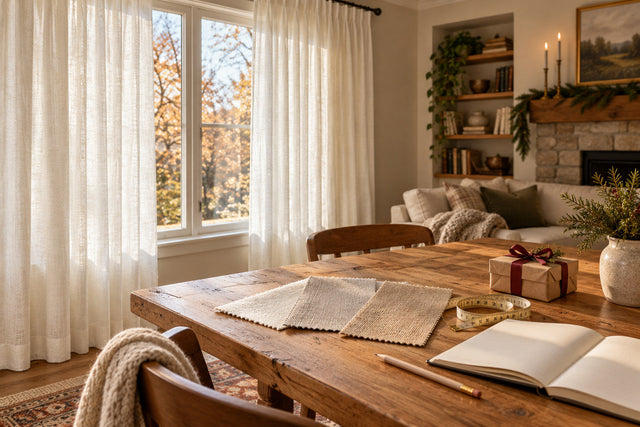
Do the same check after dark with the room lights on. A light-filtering fabric can soften daytime light without providing the coverage a guest expects at night. If privacy is the main concern, ask about the actual fabric and lining combination rather than relying on how opaque a sample looks in your hand. The lining guide is a useful starting point for that conversation.
Give daytime and bedtime separate jobs
You do not necessarily need two new layers. If an existing blind already handles nighttime privacy, the outer curtains can provide daytime framing and a softer appearance. Check that both treatments move independently and that a guest can reach the blind control without leaning across the open bed.
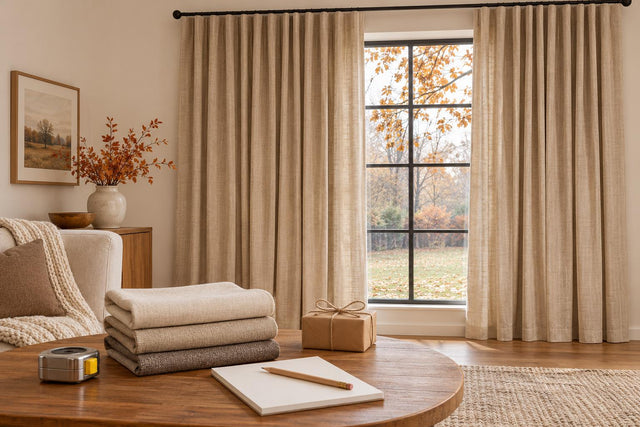
If the curtains will be the main nighttime covering, choose that configuration first. Fredesigner's Sedona linen-blend drapery gives the living room an ivory woven look by day; order the same panels with privacy or blackout lining and they can handle the guest-room night as well. Fredesigner's lining guide lists its blackout linings at a 100% shading rate, compared with 70–90% for its lighter linings.
For guests who prefer a darker sleeping space, browse blackout curtain options and check the whole window arrangement. Light can still enter above the rod, beside a panel or through a center gap. To narrow those routes, mount the rod 6–10 inches above the frame and extend it 6–15 inches beyond each side, as Fredesigner's drapery measuring guide suggests, and order the pair slightly wider than the rod so the panels overlap when closed—the curtain FAQ uses two 52-inch panels on a 100-inch rod as an example.
Rehearse the room change before measuring
Move the coffee table and unfold the bed exactly as you would for an overnight visitor. Then open and close the curtains. This short rehearsal often reveals the practical problem: a panel catches the bed frame, a stack sits behind a pillow, or the only place to stand is occupied by the nightstand.

Keep the curtain path separate from bedding and movable furniture. A hem that pools behind the sofa can be difficult to free at bedtime. If you are deciding on the length, the guide to everyday curtain hems explains the practical differences without assuming every room needs the same finish.
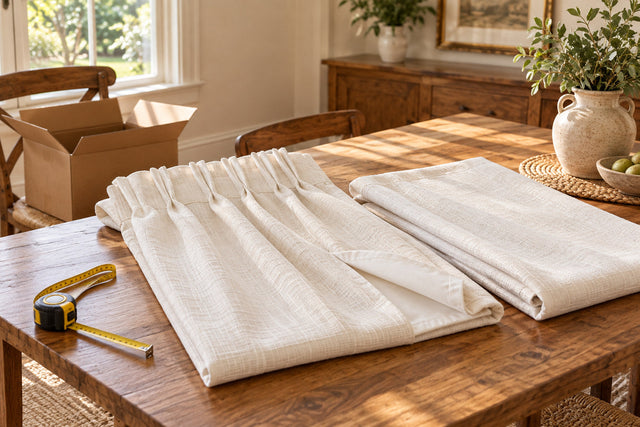
Once the layout works, use the drapery measuring instructions with the final hardware position. Do not measure while the rod location is still a guess.
Make the nighttime routine easy to explain
A guest should not need a tour of the curtain system at eleven o'clock. Leave the controls visible and accessible. If there are two layers, explain which one provides nighttime coverage and which one lets daylight in. Avoid a setup that requires reaching behind a heavy panel to operate a separate treatment.
Test the room once more with the bed open, curtains closed and a bedside light switched on. Can the person nearest the window get out without stepping on fabric? Can someone close the panels without moving the lamp? Does the morning opening routine disturb the bedding?
Include the morning, too. A guest may want to let daylight in before folding the bed back into a sofa.
The best arrangement is the one your room can repeat comfortably: curtains open for the living room, enough coverage for the sleeping space, and a clear place to stand while changing between the two.
AI-generated styling illustrations; see the product page for exact fabric and configuration.