
Before ordering patterned curtains, confirm how the pattern will be positioned across panels that hang together. A swatch shows color and a small section of the design, but not the finished meeting point, pleat placement, or full repeat. Ask about matching for the exact fabric and header rather than assuming every pair will align.
Identify which edges will be seen together
For a center-opening pair, the two leading edges meet when the curtains close. That makes the center the first place to discuss alignment. For several panels across a wide wall, identify every neighboring edge, including the joins that appear only when all panels are drawn.
Stationary side panels present a different question: you may care more about the visible motif at the leading edge than a pattern continuing across a closed opening. Explain how the curtains will be used, not simply that you want them to match.
What is the difference between pattern repeat and pattern matching?
A pattern repeat is the recurring design in the fabric; its repeat measurement describes the distance before the same motif starts again. Pattern matching is the planned alignment of that design across seams or neighboring panels. A repeat does not guarantee matching: cutting position, panel joins, and the chosen header affect which motifs appear at the meeting edges.
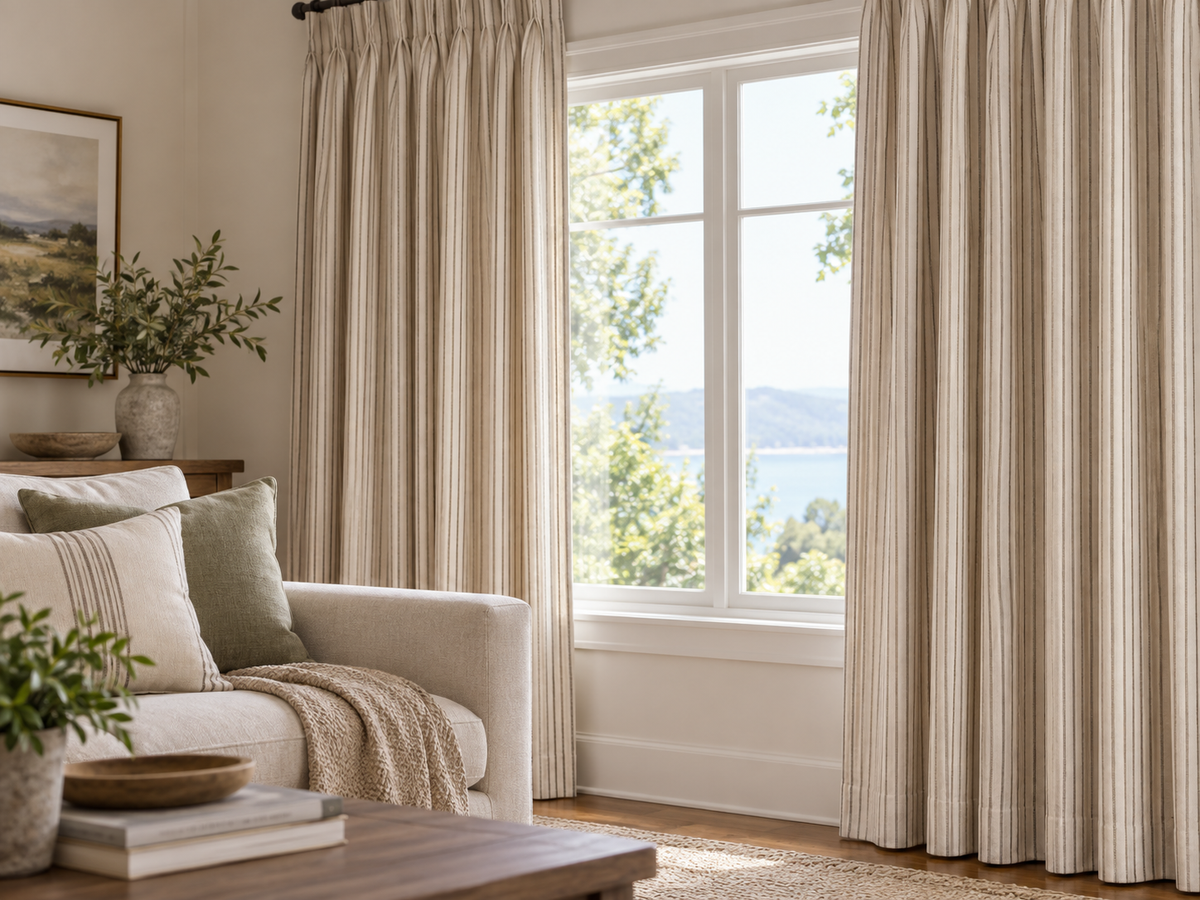
Vertical stripes, checks, and scattered motifs create different alignment questions. Even a quiet stripe can appear different when one stripe sits on a pleat face and another disappears inside a fold. Confirm the intended alignment for the exact fabric and panel group before ordering.
The Willow striped drapery panels provide a current striped product to review. Their product listing is not, by itself, a guarantee of a particular stripe position or continuous matching across your selected panel arrangement.
Send these questions before placing the order
- Can this exact fabric be pattern-matched across the panels that will hang together?
- Which edges or motifs would be aligned, and what variation should I expect?
- How does the chosen header affect the visible pattern?
- Could fabrication joins be needed for the requested dimensions, and how would they be handled?
- Does a matching request affect the available configuration, quote, or production plan?
These are questions to resolve, not services to assume are included. Keep the answer with the final product and size choices so a later change of header or width does not silently invalidate the plan.
Review a room view as well as a close-up
Look at the sample vertically beside the wall and larger upholstered pieces. Then step back to the usual seating distance. A close-up is useful for weave and color; the room view helps establish whether the pattern should lead the space or support another patterned surface.
Use the header-style guide to describe the intended curtain top. If you need matching across multiple windows, label each group instead of submitting an undifferentiated total panel count.
Keep the final specification together
Record fabric, color, header, finished dimensions, panel quantity, window group, and any confirmed matching instructions. Follow the drapery measuring guide for sizing, then browse the Curtains collection with those requirements in mind. Clarifying the meeting edges before ordering is more useful than discovering an unspoken expectation after installation.