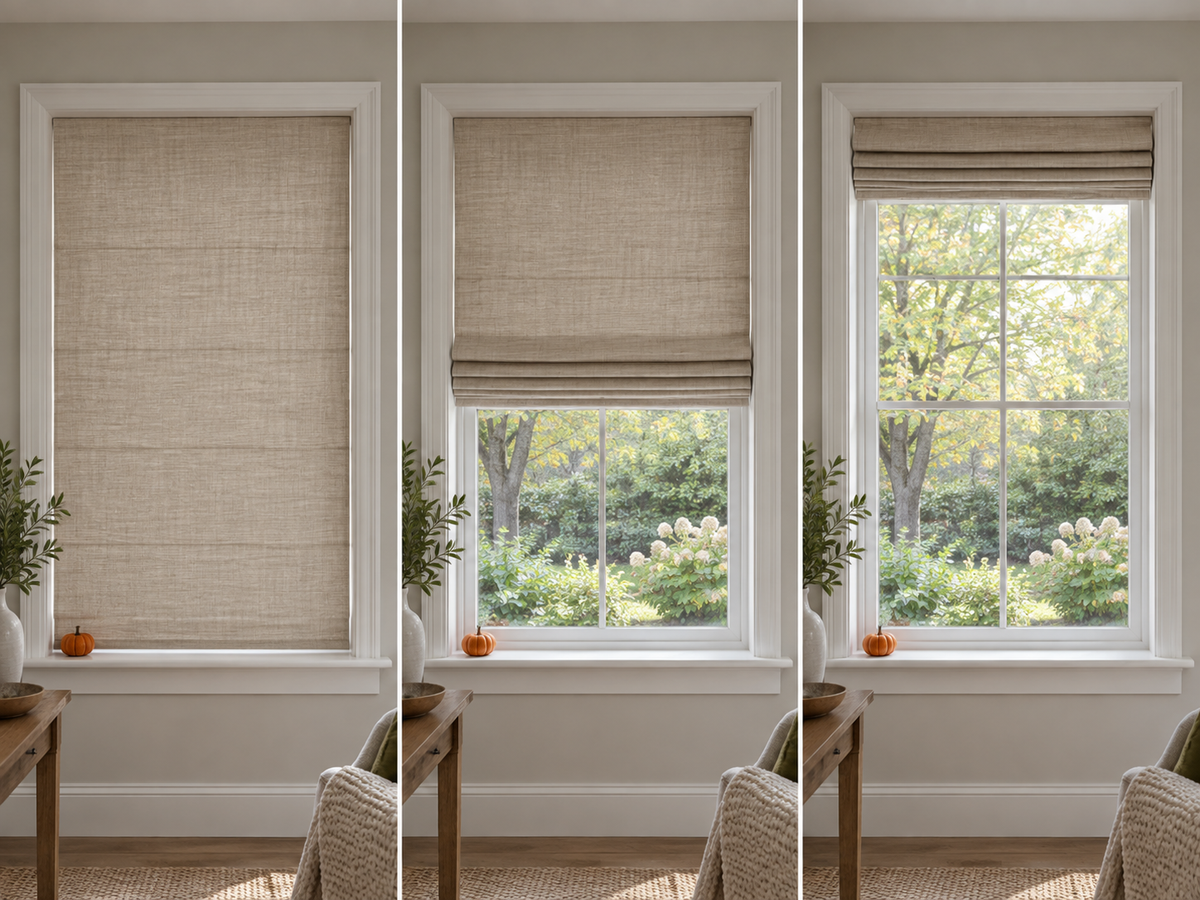
Compare Roman shades in three positions before ordering: fully lowered for fabric coverage, partly raised for the balance of view and coverage, and fully raised for the folded stack left at the top. The stack is the gathered layers of fabric. For a Halloween window, these positions determine which decorations remain visible and which parts of the glass are uncovered after dark.
What changes when Roman shades open and close?
A conventional bottom-up Roman shade gathers into folds as its lower edge rises. When fully lowered, it shows a broad area of fabric; partly raised, it exposes the lower glass; fully raised, it leaves folded fabric near the top. Start with these three views when browsing custom Roman shades, then compare photos of the particular product you are considering.
| Position | What you see | What to check |
|---|---|---|
| Fully lowered | The largest expanse of fabric across the window. | Texture, pattern placement, coverage, and the product's lining options. |
| Partly raised | Folded fabric above an exposed portion of glass. | Where the lower edge sits relative to your view, decorations, and sightlines from outside. |
| Fully raised | A stack of folded fabric near the top. | How much glass the stack covers and how it relates to the window trim. |
Why should you see the exact product in all three positions?
A fabric close-up shows color and texture; it cannot show the whole shade in use. Ask for open and closed photos of the exact product, preferably with the same fabric, lining, and fold construction you intend to order. A different style's photograph can create the wrong expectation.
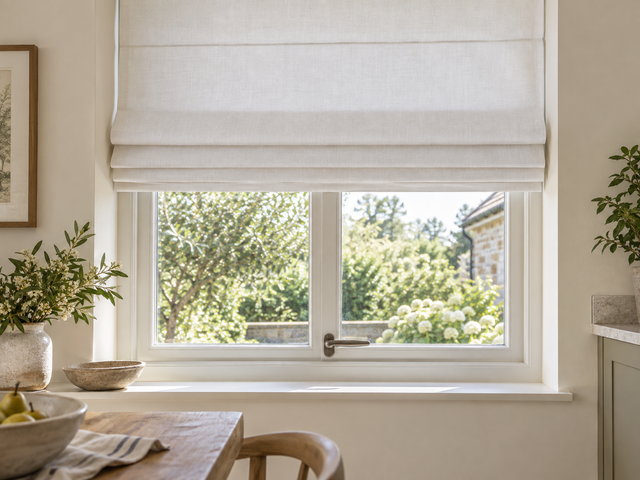
For example, if you are considering the Custom White Linen Plain Fold Roman Shade, review its product details and request any missing views before deciding. Check how the fabric lies when lowered and how the folds gather when raised. A woven texture can appear more pronounced in folded areas because light and shadow change. A printed motif may be partly concealed or repeated visually across the folds.
Do Roman shades block part of the window when fully raised?
A fully raised Roman shade can still cover some glass because the folded fabric remains near the top. The amount depends on the shade's construction, finished size, fabric, lining, and mounting position. There is no universal stack height. Check the proposed configuration before assuming the raised shade will clear the window opening.
How can you plan a Halloween window around the shade?
For Halloween 2026, decide which part of the window you want to decorate before choosing an everyday shade position. During the day, a raised shade can expose a view of the porch or yard, but the folded stack may still cover upper glass. Paper bats or a moon decal placed there could disappear behind it.
At dusk, test the partly raised position with your planned windowsill arrangement. Stand where you normally sit and check whether the fabric hides the display. Keep decorations clear of the shade's movement, and test a full raise-and-lower cycle before arranging everything. If you are planning a new shade, mark the proposed lower-edge position on a window photo to compare layouts.
After dark, lower the shade and look again. Decorations attached to the glass may be hidden from inside; a windowsill display may look different against fabric than against an open view. Our Halloween curtain ideas guide can help you plan the wider room around that changing backdrop.
Does a partly raised Roman shade provide nighttime privacy?
The uncovered glass remains an open sightline. A partly raised shade does not provide privacy across that exposed area, especially when the room is lit after dark. Lowering the shade increases coverage, but privacy and light control still depend on the fabric, lining, fit, and viewing conditions. Do not assume that a photograph of a closed shade proves blackout performance or complete nighttime privacy.
Review the Roman shades buying guide and confirm the exact product specifications for the result you need.
For an existing shade, test privacy with the room lights on: have someone observe from a place where a passerby or neighbor would normally have a view. Check both the exposed glass and the covered area. Treat that as a check of your current window and lighting, not proof that a different fabric or lining will perform the same way.
What should you confirm before placing an order?
- Mounting position. An inside mount and an outside mount place the shade differently relative to the glass and trim. Use our inside-mount versus outside-mount guide to compare the layout.
- Measurements and raised position. Follow the Roman shade measuring guide for your chosen mount. Send support your planned width, height, mount location, fabric, lining, and fold style. Ask: “For this configuration, how much glass will the fully raised shade cover?”
- Fabric in your room. Explore Roman shade fabric booklets and compare the material near the window in daylight and under your evening lighting. A small sample helps with color and texture, but does not demonstrate the finished shade's stack or full-window privacy.
Before you order, make sure you can picture the window during daily use and on Halloween evening: the view you want to keep, the decorations you want to show, and the coverage you need after dark.