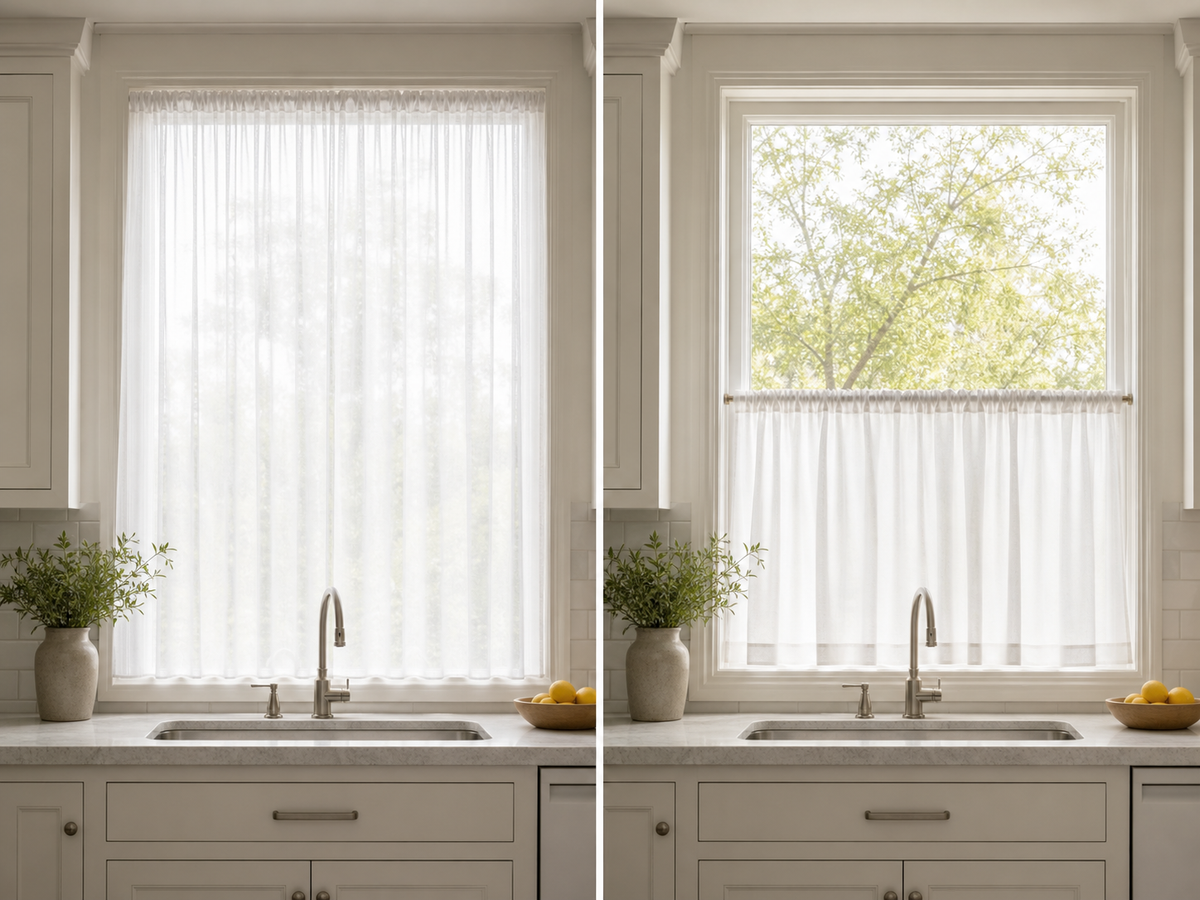

Choose sheer curtains when you want softened daylight across most or all of the window; choose cafe curtains when lower-window coverage matters more than covering the upper glass. Neither style guarantees nighttime privacy. Fabric openness, panel fullness, viewing angle, exterior light, and indoor lighting all change what can be seen from outside.
What is the practical difference?
Sheer curtains describe a light, open fabric, while cafe curtains describe a shorter coverage arrangement. A cafe curtain can use a relatively open or more opaque fabric, and a sheer panel can be full length or shorter. Separating fabric from coverage prevents a common shopping mistake.
| Decision | Sheer curtains | Cafe curtains |
|---|---|---|
| Main purpose | Soften daylight and the view | Cover the lower portion of a window |
| Typical coverage | Most or all of the opening | Lower section, with upper glass open |
| Visual effect | Soft vertical movement | Casual, compact window treatment |
| Privacy question | Depends on fabric openness and lighting | Depends on fabric plus how high coverage reaches |
| Layering option | Often paired with a more private outer treatment | Can pair with a top treatment or side panels |
Choose by the sightline you need to manage
Stand where privacy matters: at the sink, dining table, sofa, desk, or entry. Then look toward the window at the same height a person outside might see. Cafe coverage can interrupt a street-level or neighboring sightline while keeping upper glass open, but the useful height depends on the actual room and exterior grade.
Full-window sheers soften the entire view but may reveal silhouettes after dark when indoor lights are brighter than outside. Test the fabric in both directions and at different times. If nighttime privacy is essential, plan a second layer or choose a less-open main treatment so the sheer is not carrying every job.
Match the treatment to the room
Cafe curtains can fit kitchens, breakfast areas, and small windows where upper daylight is valuable and the lower view needs screening. They also keep fabric away from the floor in work areas. Check placement around faucets, handles, heat sources, and frequently opened windows before selecting hardware.
Sheer curtains fit living rooms, dining rooms, and other spaces where full-height softness matters. Browse the sheer curtain collection, then review each product's fabric, color, dimensions, header, and care. Openness and privacy vary from one sheer to another.
Layer when one treatment cannot solve both times of day
A sheer inner layer can manage bright daytime views while a more private curtain closes at night. The layers need enough rod depth and clearance to move independently. Check how the panels will stack so the window can still open when full daylight is wanted.
The liner and interlining guide explains qualitative privacy and light-control choices, but availability remains product-specific. For a broader outer layer, use the curtains and drapery collection and review the options before ordering.
Measure the finished treatment, not only the glass
Plan hardware position first. Record finished width and finished length in inches, note trim and handles, and decide how the panels should overlap or clear the sill. Fredesigner's drapery measuring guide provides the measuring method. For a concise planning sequence, read the custom curtain measuring checklist.
For cafe coverage, add the intended top and bottom positions to a window sketch. For a layered sheer, show both rods or tracks and the space each treatment needs when open. Use only allowances that apply to the selected header and product.
Compare samples under real lighting
Order fabric samples when available and check the listed price and eligibility before checkout. Hold each sample against the window during the day, then repeat the test after dark with the room lights on. Look through the material from both sides and fold it over itself to understand how added fullness changes the view.
Fredesigner's fabric selection guide can help organize opacity, texture, room use, and lining decisions. Use the guide qualitatively, then let the product information settle the final fabric choice.
A quick decision sequence
- Identify the indoor and outdoor sightlines that matter.
- Decide whether the upper glass should remain open.
- Choose full-window, lower-window, or layered coverage.
- Compare fabric openness in daylight and after dark.
- Plan hardware, stacking space, and window operation.
- Measure the finished treatment in inches with the published guide.
- Recheck material, header, size, care, price, and availability on the product page.
Sheer and cafe curtains solve different parts of the same problem. Start with the coverage line, then choose a fabric and second layer that support the room at both daytime and nighttime.