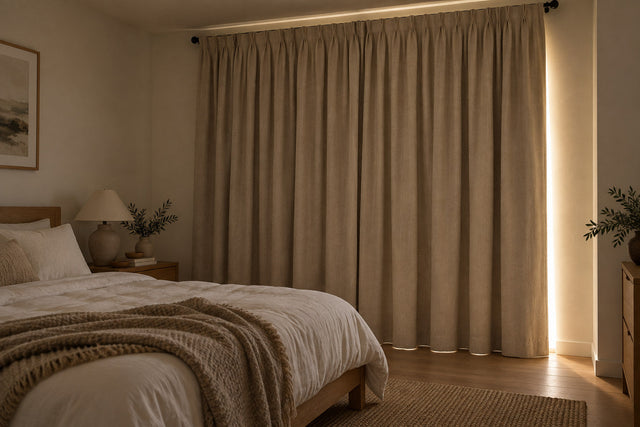

Choose the mounting position before you order the curtain length. Ceiling-mounted and wall-mounted curtains can both work well, but they place the fabric on different paths and use different fixing surfaces. The right choice depends on the space above the window, what the curtain must clear and where suitable hardware can be securely installed.
A favorite photograph can help you choose the look. It cannot tell you whether your ceiling construction, wall or window trim will support that installation.
Look above the window, then look sideways
Start with a photo of the full wall, including the ceiling. Note any crown molding, deep trim, sloping section or built-in cabinet. A narrow strip of wall above the frame may leave little room for a bracket; decorative molding may interrupt an otherwise simple ceiling line.
Next, take a side view. A deep sill, outward-moving window handle or existing blind can require the curtain to hang farther into the room. Mounting on the ceiling does not remove that clearance question. The ceiling track still needs a position that lets the fabric pass everything beneath it.
Mark the proposed curtain path without drilling or attaching anything to an unknown surface. You are checking the layout at this stage. An installer can then assess the construction and specify hardware and fixings for the intended curtain weight.
When a ceiling mount makes sense
A ceiling-mounted track can be useful when there is little uninterrupted wall above the window or when you want a long, clean fabric line. In a room with tall glazing, the track can keep the top visually simple. The curtain usually hangs close to that line, though the actual drop still depends on its attachments.
Check the opening position as well as the closed position. A track running across a whole wall does not mean the curtain must cover the whole wall. Decide where each panel will park and whether those folds will crowd a bookcase, light fitting or door.
Ceiling mounting needs appropriate hardware and a suitable fixing surface. Do not assume a suspended ceiling, decorative board or unknown ceiling material will carry a lined curtain. If the surface needs reinforcement, resolve that before ordering the fabric.
When a wall mount is the clearer choice
A wall-mounted rod or track gives you more freedom to choose the height above the frame. It can also be easier to coordinate with substantial crown molding, provided there is a suitable mounting area below it. The brackets control how far the curtain sits in front of the wall.
The visible rod becomes part of the room. That may suit a casual sitting room or a bedroom with other dark metal details. A wall track can be more discreet if you prefer less visible hardware. Our rod-or-track guide covers that separate choice.

Do not choose a bracket purely because it looks compact. Ask whether its projection clears the trim and whether the hardware is intended for the selected header, width and finished curtain weight.
| Decision | Ceiling mount | Wall mount |
|---|---|---|
| Where it is supported | A suitable ceiling surface, assessed for the intended load | A suitable wall surface, with brackets assessed for the intended load |
| What may interrupt the position | Ceiling construction, molding or a sloping section | Limited wall space above the frame or deep trim |
| What sets the curtain path | The track position and its attachments | The rod or track height, bracket projection and attachments |
Let the mounting decision set the measurements
A curtain ordered for a wall rod may be too short when moved to a ceiling track. A ceiling-height curtain may trail on the floor if the hardware is later lowered. The starting point is the final hardware and attachment, not the top of the glass.
Review the header options with the hardware you plan to use. Then follow Fredesigner’s drapery measuring instructions for that configuration. Confirm any deductions or attachment allowances before submitting the order; do not add your own adjustment to a measurement that already includes one.
Sedona linen-blend drapery has a visible woven texture that can soften a simple window wall. Its product name does not establish compatibility with a particular ceiling track. Compare the ordered header and lining with the hardware requirements, or browse the linen curtain collection once those requirements are clear.
Finally, stand where you enter the room and check the full line: mounting height, curtain edges and hem. If the visual choice works but the fixing surface is uncertain, send the ceiling and wall photos through Fredesigner’s contact page and ask your installer to resolve the support question. Make that decision before committing to a custom drop.