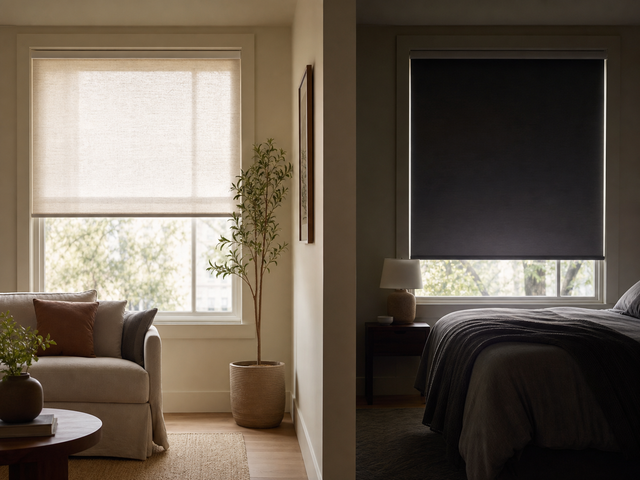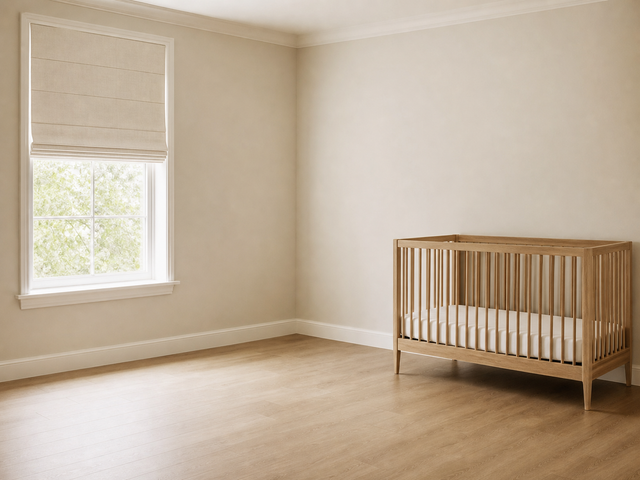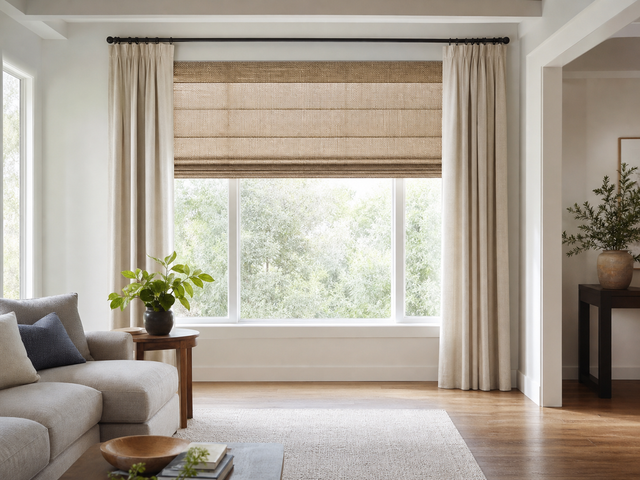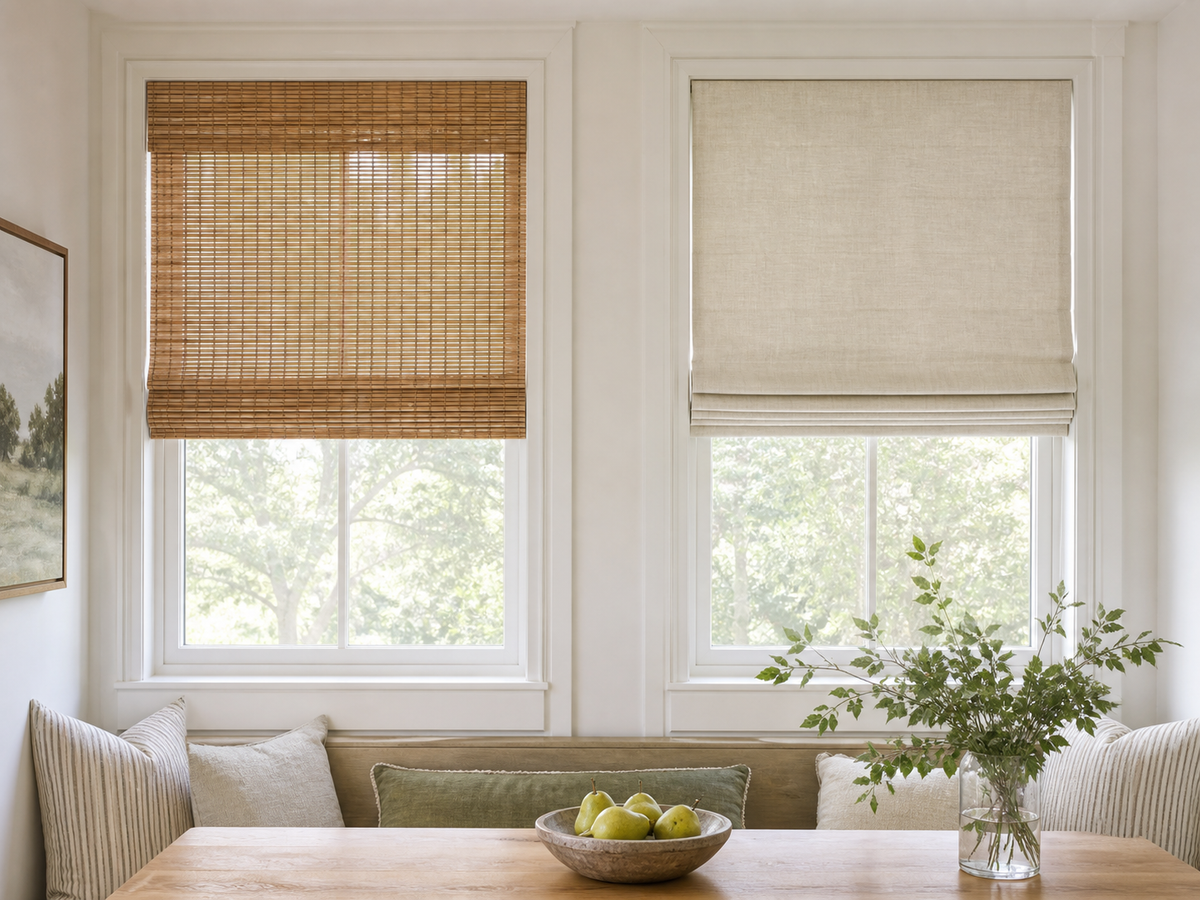

Bamboo shades bring visible weave and natural variation to a room; fabric Roman shades create a softer, more continuous surface. Place each beside the room's wood, upholstery, and wall color before deciding. Nighttime privacy and darkness still depend on material, liner, mount, and edge coverage.
What is the main difference?
Bamboo and woven shades make their texture visible. Small variations in tone and spacing are part of the material's appearance, so the shade can become a strong surface in an otherwise simple room.
Fabric Roman shades create folds from a continuous textile. They can look quieter and more uniform, although the result still changes with weave, color, lining, fold style, and room light.
| Decision | Bamboo or woven shade | Fabric Roman shade |
|---|---|---|
| Visual character | Pronounced weave and natural variation | Softer, more continuous fabric surface |
| Daylight | Often softened through the weave; the result varies by weave | Depends on fabric opacity and selected liner |
| Privacy | Must be checked by weave, liner, and nighttime lighting | Must be checked by fabric, liner, mount, and gaps |
| Color consistency | Variation may be visible | Usually more uniform, but dye lots and room light can differ |
| Room pairing | Works well with wood, stone, plaster, and simple textiles | Works across tailored, classic, and softer layered rooms |
| Final fit | Choose mount and measure width, height, and depth | Choose mount and measure width, height, and depth |
Choose bamboo for texture, not a blanket performance claim
The Bamboo Roman Shade collection presents many shades around natural texture. That makes it a useful starting point for warm, tactile window treatments.
A tight weave and an open weave can behave differently in daylight and after dark. Read the product's material, weave, liner, and control details before deciding.
Treat bamboo as a material and design choice, not automatic proof of a health, environmental, or durability benefit. Those claims require product-specific evidence. Choose the treatment for disclosed details, appearance, fit, and room use.
Choose fabric Roman shades for a more uniform surface
Fredesigner's Custom Roman Shades collection includes light-filtering, privacy, plain-fold, textured-sheer, and top-down/bottom-up options. These choices provide different visual and functional starting points.
Fabric can make it easier to coordinate the shade with upholstered furniture, bedding, or curtains. It can also provide a quieter background when the room already contains strong wood grain, patterned rugs, or stone.
The collection name is only a starting point. Check the fabric, liner, mount, lift, and ordering fields on the selected shade.
Compare privacy in the real room
Daytime privacy does not prove nighttime privacy. Interior lights can make an open weave or lighter fabric easier to see through after dark. The room scenarios in Light Filtering vs Blackout Window Treatments can help define the amount of light control you need before comparing materials.
For a street-facing room, hold the relevant sample near the window and view it from both sides under daytime and nighttime lighting. Check the listed sample price and make sure it corresponds to the product.
If privacy is essential, compare liner choices and edge coverage. A liner can change the appearance or operation differently across shade designs.
Match the material to the room
Living room
Bamboo can add contrast to smooth walls and simple upholstery. Fabric Roman shades can blend more quietly with curtains or repeat a textile already used in the room.
Bedroom
Start with privacy and desired darkness. Either material can be considered, but the liner, mount, and edge gaps determine whether it meets the bedroom's needs.
Kitchen or dining area
A compact shade can keep fabric away from the floor, but check clearance from handles, counters, faucets, and heat or moisture sources. Follow the care information for the selected material because woven and fabric shades may need different handling.
Home office
Consider screen glare, view, and how often the shade will move. A visible woven texture may soften a simple workspace, while a fabric shade can provide a more uniform backdrop.
Inside mount or outside mount?
Inside mount gives either shade a fitted appearance when the frame has enough usable depth. The opening must also be clear of handles, cranks, screens, and uneven trim.
Outside mount can work around a shallow frame and add coverage around the opening. It may also cover more trim or wall area, so mark the finished edges before measuring.
Use the Roman Shade Measuring Guide for width, height, depth, and mount planning. Keep measurements and any stated deductions tied to the shade you order.
Let the room settle the material question
Place the relevant samples vertically at the window instead of flat on a table. View them beside the floor and largest upholstered piece in daylight, then turn on the room lights after dark. The woven option may echo wood grain and stone; the fabric option may relate more quietly to a sofa, bed, or curtain panel.
After the visual choice, return to privacy, care, mount, and operation. If full-length panels are still under consideration, Blackout vs Room Darkening Curtains shows how curtain fabric and installation work together. Measure only for the treatment you select, and contact Fredesigner support when a material or configuration detail remains unclear.